Study Intakes in Spain: September, January, and Alternative Start Dates Explained
Spain has quickly risen to the top of Europe’s most appealing study destinations. Between world-ranked business schools, low tuition fees at public universities, and a rapidly expanding catalog of English-taught degrees, international applications are at an all-time high.
However, navigating the Spanish admissions calendar is notoriously tricky. Unlike countries such as the UK, Canada, or Australia—where rolling admissions and multi-intake cycles are standard across almost all degree types—Spain operates predominantly on a single, centralized annual intake for public education.
Missing an application cutoff in Spain often means delaying your plans by an entire academic year. Here is a realistic breakdown of Spain’s primary intakes, how private and public universities differ, and how to structure your application timeline.
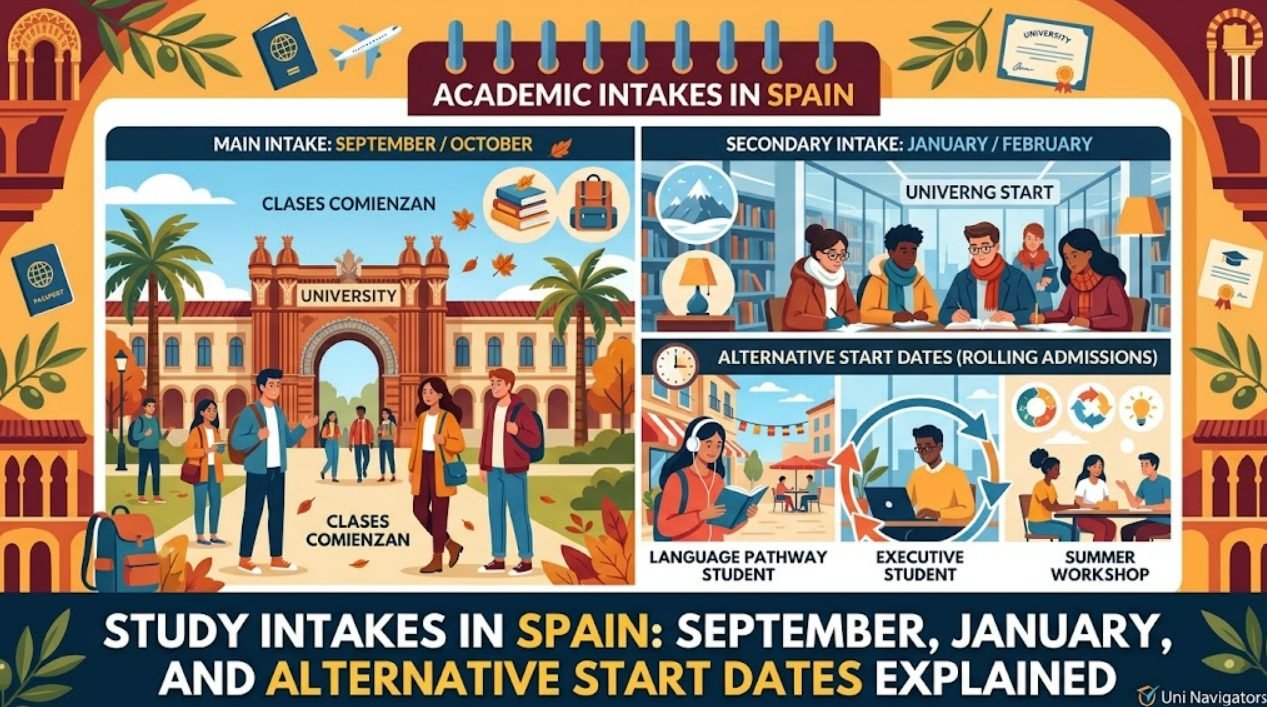
The Primary Intake: September / October (Fall Semester)
The September intake (Primer Semestre or Convocatoria Ordinaria) is Spain's main academic entry point. Virtually 100% of undergraduate degrees and the vast majority of official Master’s programs begin during this period.
If you are targeting a public university—such as the University of Barcelona, Complutense University of Madrid, Autonomous University of Barcelona, or the University of Valencia—this is the cycle you must target.
Key Timelines
Application Period (Phase 1 / Ordinary): February – June
Late Applications (Phase 2 / Extraordinary): July – September (reserved strictly for remaining spots; rarely practical for non-EU students who need a visa)
Admissions Results: June – July
Classes Begin: Mid-September to early October
Pros of the September Intake
Complete Program Access: All fields, from engineering and medicine to humanities and business, admit their primary cohorts.
Scholarship Deadlines: National and regional scholarships (such as MAEC-AECID grants) exclusively target Fall starters.
Campus Integration: Student housing leases, university orientation (Semana de Bienvenida), and campus clubs align with this intake.
Cons
High Competition: Popular programs fill up in Phase 1.
Visa Bottlenecks: Spanish consulates worldwide experience their highest volume between June and August. Delays of 6 to 10 weeks for student visa appointments are standard.
The Secondary Intake: January / February (Spring Semester)
Many prospective students assume Spain offers an open winter intake equivalent to Germany or the UK. In Spain, the January/February intake (Segundo Semestre) is limited and behaves quite differently.
Public universities rarely admit new undergraduate students in January. With few exceptions, Spring intake is dominated by:
Private Universities & International Business Schools (e.g., EU Business School, GBSB Global, TBS Education Barcelona, Geneva Business School, Schiller International University).
Select University Master’s Programs (Másteres Propios or specific specialized postgraduate degrees).
Study Abroad & Exchange Students entering for one semester via bilateral Erasmus or non-EU exchange agreements.
Key Timelines
Application Period: September – November
Admissions Results: November – December
Classes Begin: Late January to mid-February
Pros of the January Intake
Shorter Visa Waiting Times: Spanish consulates are significantly less crowded in late autumn than in the summer rush.
Ideal Recovery Option: If you missed document deadlines for September or experienced delays legalizing your high school diploma, January provides a safety net without losing a full calendar year.
Smaller Class Sizes: Spring cohorts are usually more compact, allowing for greater individual interaction with faculty.
Cons
Limited Program Catalog: Very few STEM or public healthcare courses operate a second semester start.
Higher Reliance on Private Tuition: Because options are concentrated in private institutions, tuition costs for this intake skew higher on average.
Alternative Start Dates: Rolling Intakes and Pathways
If September is too soon and February doesn’t align with your graduation, alternative academic routes offer flexible entry points throughout the year.
1. Rolling Intakes at Private International Institutions
Many private English-medium business schools and liberal arts colleges in Madrid, Barcelona, and Marbella operate on quarterly or modular schedules:
Typical Start Terms: October, January, April, and July/August.
Application Style: Rolling admissions, accepting applications until class seats are full.
2. Spanish Language Preparation (Year-Round Intakes)
For international students who wish to study in Spanish but currently sit at an A2 or B1 level, university-affiliated language schools (Centros de Idiomas) run intensive DELE/SIELE pathway programs:
Intakes: Monthly or every semester (October, January, March, and June).
Strategic Advantage: Entering Spain on a long-term student visa for an accredited language pathway allows you to live in Spain, adapt to the country, and complete the UNEDasiss credential evaluation locally before transitioning into a degree program the following September.
3. Summer Schools & Pre-Master’s (June / July)
A 4- to 8-week summer term allows students to earn preliminary European Credit Transfer System (ECTS) credits, complete prerequisite quantitative courses, or settle into student accommodation before the demanding Fall semester begins.
Intake Comparison at a Glance
| Feature | September (Fall) Intake | January/February (Spring) Intake | Alternative / Rolling Dates |
| Available Institutions | Public & Private Universities | Mainly Private Universities & Business Schools | Private Universities, Language Academies, Foundations |
| Degree Levels | Bachelor’s, Master’s, PhD | Select Master’s, Business BAs, Exchange | Diplomas, Language Pathways, Executive Master’s |
| Application Deadlines | April – June (Non-EU) | October – November | 2–3 months prior to each start date |
| Visa Pressure | Extreme (June–August peak) | Moderate | Low to moderate |
| Tuition Range | €800 – €18,000 / year | €6,000 – €22,000 / year | Varies by program length |
Navigating the International Timeline: The 9-Month Roadmap
International admissions in Spain involve strict bureaucratic procedures before you ever sit in a classroom. For non-EU students, the university application itself is only one part of the equation.
9 Months Out ──> Legalize transcripts (Hague Apostille / Consular legalisation) 6 Months Out ──> Submit UNEDasiss or Homologation credentials 4 Months Out ──> Receive University Acceptance Letter 3 Months Out ──> Submit Type D Student Visa application 1 Month Out ──> Secure housing & fly to Spain Arrival ──> Apply for TIE (Foreigner Identity Card) within 30 daysStep 1: Document Legalisation (9 to 7 Months Out)
Your secondary school diploma, university degree, and transcripts must be stamped with the Hague Apostille (or legalized via diplomatic channels if your home country is not an Apostille signatory). Non-Spanish documents must then be translated by an official Spanish Sworn Translator (Traductor Jurado).
Step 2: Credential Recognition (Homologación or UNEDasiss) (6 to 5 Months Out)
Undergraduate applicants: You must apply for credential conversion through UNEDasiss, the centralized service that validates foreign high school diplomas and calculates your admission score (Nota de Corte).
Master’s applicants: You will either complete internal degree equivalence directly through your chosen university’s admissions office or apply for official Homologación.
Step 3: University Application & Acceptance (5 to 4 Months Out)
Submit applications directly to regional admission portals (e.g., the Madrid or Catalonia public systems) or to private institution portals. Pay the seat deposit to obtain your official Letter of Acceptance (Carta de Admisión).
Step 4: The Student Visa Application (3 Months Out)
Apply for a long-stay National Type D Student Visa at your local Spanish consulate or embassy. Crucial requirements include:
Official letter of acceptance from an accredited institution.
Proof of economic means (pegged to Spain’s IPREM index; minimum of approximately €600 per month of study).
Spanish private health insurance with zero copay (sin copago) and full repatriation coverage, authorized to operate in Spain.
Medical certificate and police clearance certificate (both apostilled and translated).
Making the Right Choice for Your Studies
Choosing the right intake depends on your background and target discipline:
Choose September if you want low-cost public university tuition, STEM/specialized humanities degrees, or maximum scholarship opportunities.
Choose January if you are pursuing a business, hospitality, or digital marketing degree at an international private school, or need extra time to compile your financial and academic paperwork.
Choose a Language Pathway first if you want to study an undergraduate degree taught in Spanish but need to pass the official B2/C1 exams.
Navigating UNEDasiss, apostilles, sworn translations, and consular appointments requires precision. The counselors at Uni Navigators handle end-to-end applications for international students looking to study in Spain, matching your academic profile with the right intake and ensuring your visa documentation satisfies Spanish consular requirements.