
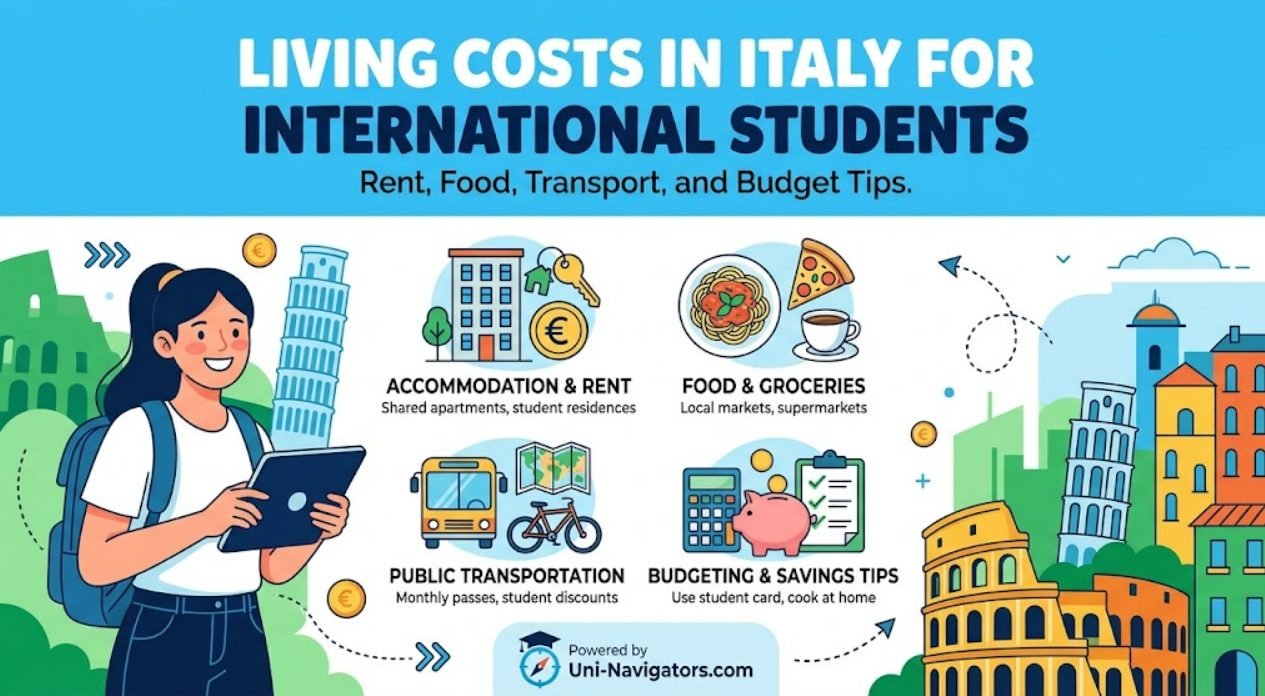
Living Costs in Italy for International Students: Rent, Food, Transport, and Budget Tips
Italy has steadily climbed to the top of study-abroad wishlists, and it is easy to understand why. Between historic campuses like the University of Bologna and Sapienza University of Rome, globally renowned programs at Politecnico di Milano, and remarkably accessible public tuition fees, the country offers world-class education without the staggering price tag common in the UK or the US.
However, tuition is only half of the financial equation. To avoid mid-semester financial stress, you need an honest, granular picture of what everyday life in Italy actually costs.
On average, international students in Italy spend between €700 and €1,350 per month. Where you land within that spectrum depends almost entirely on your university city, your housing choice, and how smart you are with everyday expenses.
Below is your complete guide to managing your finances as an international student in Italy.
At a Glance: Typical Monthly Student Budget
| Expense Category | Frugal / Budget City | Average / Tier-2 City | High-Cost City (Milan / Central Rome) |
| Accommodation (Single room in shared flat) | €250 – €400 | €350 – €550 | €550 – €800+ |
| Groceries & Food | €150 – €200 | €180 – €240 | €220 – €300 |
| Public Transportation | €20 – €30 | €25 – €35 | €22 – €39 |
| Utilities & Home Wi-Fi (Your share) | €40 – €60 | €50 – €80 | €70 – €120 |
| Mobile Phone Plan | €8 – €12 | €8 – €12 | €8 – €15 |
| Leisure & Personal Expenses | €80 – €120 | €100 – €160 | €150 – €250 |
| Estimated Monthly Total | €548 – €822 | €713 – €1,077 | €1,020 – €1,524 |
1. Accommodation: Your Biggest Monthly Outflow
Rent accounts for roughly 50% to 65% of your living expenses in Italy. Finding housing early is essential, as vacancy rates in major university towns can be tight.
Accommodation Types
Single Room (Stanza Singola): The most common choice. You rent a private bedroom in an apartment shared with 2 to 4 other students and split the kitchen and bathroom. Costs range from €300 to €550 in mid-sized cities, but climb to €600 to €850 in central Milan or Rome.
Shared Room (Posto Letto / Stanza Doppia): Sharing a bedroom with another student is the easiest way to cut costs. Expect to pay €200 to €350 per month, depending on the city.
University Residences (DSU Dorms): Public university dormitories, managed through regional student welfare offices (Diritto allo Studio Universitario), charge between €150 and €350 per month. Spots are awarded strictly based on family income and academic merit, and demand always exceeds supply.
Private Student Residencies: Modern co-living chains (such as Camplus or Collegiate) offer en-suite studios with gyms and study lounges. These are convenient but run higher: €650 to €1,200+ per month, all bills included.
Hidden Rental Expenses to Watch Out For
Condominium Fees (Spese Condominiali): Always ask whether the advertised rent includes building maintenance, elevator upkeep, and stair cleaning. If not, this adds an extra €20 to €60 monthly.
Security Deposit (Caparra): Landlords typically request 2 to 3 months of rent upfront as a refundable deposit. Keep this liquid before arriving.
Contract Registration (Registrazione Contratto): In Italy, leases exceeding 30 days must be registered with the Agenzia delle Entrate. Under standard Cedolare Secca contracts, registration is free for tenants; standard contracts may require splitting a minor registration fee.
2. City-by-City Comparison: Where You Study Determines What You Spend
The cost disparity between Northern and Southern Italy is real, and it directly affects your monthly bank balance.
Tier 1: High Cost (Milan and Rome)
Monthly Budget: €1,000 – €1,500
Milan is Italy's financial and design capital. While universities like Bocconi and PoliMi offer outstanding career networking, housing is at a premium.
Rome offers a slightly broader range of neighborhoods, but living within easy reach of Sapienza or Tor Vergata still requires a solid budget.
Tier 2: Moderate Cost (Bologna, Florence, Padua, Turin)
Monthly Budget: €700 – €1,100
Bologna and Padua are true university towns where students make up a large percentage of the population. They are vibrant and bike-friendly, though housing competition in Bologna is notoriously fierce.
Turin stands out as exceptional value for money: it hosts world-class institutions like Politecnico di Torino, yet apartment rents remain 20% to 35% lower than in nearby Milan.
Tier 3: Budget-Friendly (Naples, Pisa, Siena, Bari, Messina)
Monthly Budget: €550 – €800
Southern and coastal universities offer a significantly lower cost of living. Groceries, fresh produce, and private rentals in cities like Naples or Bari can be half of what you would pay in Milan.
3. Food and Groceries: Eating Well on a Budget
Italian food culture is unbeatable, and eating well does not require a luxury budget if you adopt local habits.
Monthly Groceries: Budget €150 to €230 for standard home cooking. Discount supermarket chains such as Eurospin, Lidl, Penny Market, and MD offer staple goods at a fraction of the cost found at high-end express markets. For fresh fruit, vegetables, and cheeses, local open-air neighborhood markets (mercati rionali) are often both fresher and cheaper.
The University Canteen (Mensa): Every public university operates a subsidized mensa. A complete meal—including a pasta course, meat or vegetarian main, side dish, bread, and fruit—costs between €2 and €6, depending on your ISEE financial documentation tier.
Dining Out & Aperitivo: A sit-down dinner at a casual trattoria runs €15 to €25. If you want to socialize affordably, lean into the aperitivo: for €7 to €12, you get an evening beverage accompanied by small plates or a food buffet.
4. Public Transportation: Affordable and Reliable
Getting around Italian cities is straightforward and heavily subsidized for students.
Urban Transit Passes: A monthly student card covering buses, trams, and metro lines averages €20 to €35. In Milan, an under-26 ATM transit pass is approximately €22 per month; Rome and Turin offer similar discounted annual or monthly schemes for young residents.
Bicycles & Scooters: Cities like Bologna, Padua, and Florence are flat and compact. Buying a secondhand bicycle or using a subsidized municipal bike-share scheme (€15–€25/year) often eliminates the need for daily transit passes altogether.
Intercity Travel: Trenitalia and Italo operate high-speed rail lines connecting major cities. Sign up for youth discount cards (CartaFRECCIA Giovani or Italo Più) to secure up to 40%–70% off high-speed train tickets when booking trips across Europe.
5. Utilities, Healthcare, and Administrative Fees
Do not overlook regular operating costs and one-off statutory fees when drafting your pre-departure checklist.
Electricity, Gas, and Heating (Bollette): Utility bills depend on whether your apartment has central heating (riscaldamento centralizzato) or independent heating (autonomo). In Northern winters, heating spikes bills. Expect your share in a multi-tenant flat to be €50 to €90 per month.
Mobile SIM: Italian mobile plans are among the cheapest in Europe. Providers like Iliad, ho. Mobile, and Spusu offer 100GB to 200GB of 5G data with unlimited calls for just €7.99 to €9.99 per month.
Residence Permit (Permesso di Soggiorno): Non-EU students must apply for this permit within 8 working days of arrival in Italy. The postal kit, administrative stamps (marca da bollo), and issuance fees total approximately €120 to €150 annually.
Health Coverage (SSN): Non-EU students can register with Italy's National Health Service (Servizio Sanitario Nazionale), granting full access to a family doctor and public hospitals. Alternatively, international students can opt for approved private student health insurance policies starting around €120 to €150 per year for visa compliance purposes.
6. Scholarships and Working Rights: Offsetting Your Expenses
You do not have to shoulder the cost of living alone. Italy provides multiple avenues to supplement your student budget:
Regional DSU Scholarships
Every Italian region offers need-based DSU scholarships. These grants are assessed using your ISEE Parificato (an economic indicator calculated from your home country’s household income and assets). Successful applicants can receive:
Full university tuition waiver.
Free or subsidized university dormitory placement.
Free daily meals at the university mensa.
An annual living stipend ranging between €3,000 and €7,000, paid directly to the student.
Part-Time Work Regulations
Under Italian law, non-EU students holding a valid study permit (Permesso di Soggiorno per Studio) are legally permitted to work up to 20 hours per week, with a cumulative cap of 1,040 hours per calendar year. Common student roles include university campus assistantships (collaborazioni a tempo parziale or 150-hour contracts), hospitality, teaching English, and remote freelancing.
5 Practical Budget Tips for Studying in Italy
Submit Your ISEE Parificato Early: Filing your income certificates before the regional deadlines is the single most impactful financial step you can take. It can turn a €3,000 tuition bill into €150 and unlock monthly meal grants.
Shop at the Perimeter: City-center express grocery markets carry steep markups. Take the bus or walk 15 minutes outward to shop at hypermarkets where locals buy in bulk.
Drink Your Espresso at the Counter: In Italian coffee shops, sitting at an outdoor table often adds a table service charge (servizio / coperto). Do what Italian university students do: stand at the bar (al banco) for a €1.20 to €1.50 espresso.
Acquire a Codice Fiscale Immediately: You need this Italian tax code to sign a rental lease, purchase an annual transit pass, set up a local bank account, and buy an Italian SIM card. Obtain it through the Italian consulate before traveling or at the local tax office (Agenzia delle Entrate) upon arrival.
Look Along Regional Train Corridors: If studying in Milan or Florence, you do not have to live inside the inner ring. Towns 20 to 30 minutes away on the regional commuter line offer rents that are 30% to 50% cheaper.
Plan Your Study Abroad Journey with Uni-Navigators
Figuring out foreign student visas, translation of financial records, scholarship applications, and university admissions can feel daunting. At Uni-Navigators, we guide students step-by-step through:
University and course selection across Italy, the UK, Europe, the USA, and Canada.
Universitaly portal pre-enrollment and document validation (Declaration of Value / CIMEA).
ISEE Parificato documentation and regional DSU scholarship submissions.
Student visa file preparation and mock visa interviews.
Ready to start your Italian university journey? Connect with our education consultants today through Uni-Navigators for personalized, end-to-end guidance.