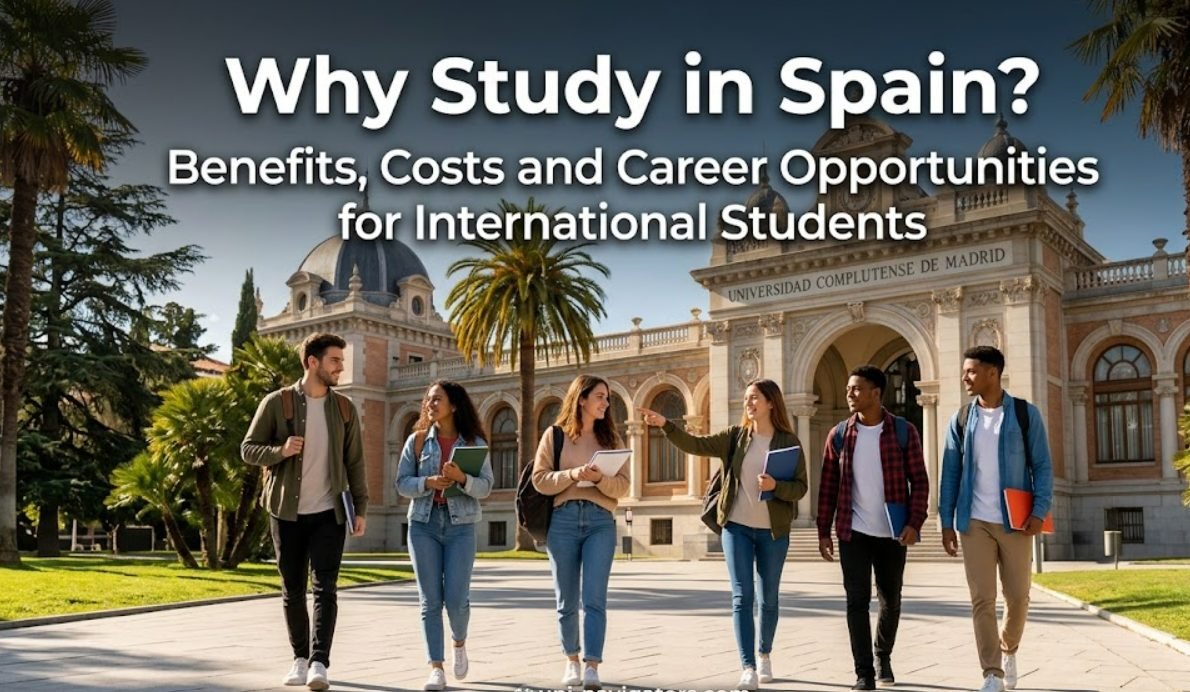
For years, international students eyeing Europe gravitated almost reflexively toward the UK, Germany, or the Netherlands. Yet over the last few academic cycles, Spain has quietly transformed into one of the most compelling higher education hubs on the continent.
With tuition fees that are a fraction of the cost in Anglophone nations, a rapidly expanding catalog of degrees taught 100% in English, and progressive immigration policies that permit up to 30 hours of part-time work per week, Spain offers an unmatched balance of academic prestige and quality of life.
Whether you are seeking an affordable undergraduate degree or a globally accredited master’s to accelerate your career, here is everything you need to know about studying in Spain as an international student.
1. Academic Excellence and Global Degree Recognition
Spain operates strictly within the European Higher Education Area (EHEA) and follows the Bologna Process. This means any bachelor’s (Grado), master’s (Máster Universitario), or doctorate (Doctorado) earned in Spain is universally recognized across the European Union, the UK, the United States, Canada, and Australia.
Spanish universities consistently perform well in global rankings, particularly across business, biomedical sciences, architecture, and civil engineering:
Top Public Research Universities: Universitat de Barcelona (UB), Universidad Autónoma de Madrid (UAM), Complutense University of Madrid, and Universitat Pompeu Fabra (UPF).
World-Ranked Business Schools: Institutions like IE Business School, ESADE, and IESE regularly rank among the top 10 European business schools in the Financial Times rankings.
Historic Heritage: Universities like the University of Salamanca (founded in 1218) combine eight centuries of academic tradition with modern research labs.
2. English-Taught Degrees & The Spanish Language Advantage
A common myth is that you must speak fluent Spanish to earn a degree in Spain. While learning the local language is invaluable for daily life, hundreds of bachelor’s and master’s programs are taught entirely in English, particularly in fields like international business, data science, hospitality management, software engineering, and international relations.
Studying in Spain also gives you the chance to graduate bilingual. Spanish is the second most spoken native language in the world, with over 500 million native speakers across Latin America, Spain, and North America. Having a recognized European degree alongside conversational or professional Spanish (B2/C1 level) immediately sets your CV apart in the global corporate market.
3. Real Costs: Tuition Fees and Living Expenses
One of Spain's strongest competitive advantages is affordability. Unlike countries where non-EU students face steep price premiums, public university tuition in Spain remains accessible.
University Tuition Fees
Tuition in Spain is calculated by ECTS credits (a standard academic year consists of 60 credits):
| Institution Type | Average Annual Tuition (Undergraduate) | Average Annual Tuition (Master's) |
| Public Universities | €800 – €3,500 / year | €1,200 – €4,200 / year |
| Private Universities & Business Schools | €6,000 – €18,000 / year | €9,000 – €25,000+ / year |
Note: Public university tuition is set at the regional level. Regions like Andalusia (Granada, Seville) and Valencia offer lower per-credit rates for international students compared to Madrid or Catalonia.
Monthly Cost of Living
Living costs in Spain are noticeably lower than in neighboring France, the UK, or the Nordic countries:
Madrid & Barcelona: €900 – €1,300/month (Rent: €450–€750 in a shared student flat; Food & Transport: €350–€450).
Valencia, Seville, Granada, & Salamanca: €650 – €900/month (Rent: €250–€450; Food & Transport: €250–€350).
Public transportation is heavily subsidized for youths and students, with monthly metro and bus passes often discounted down to €10–€20 in major metropolitan areas.
4. Working While Studying: The 30-Hour Rule
Spain's updated immigration framework (RD 1155/2024) significantly improved conditions for international students:
Automatic Work Authorization: For students enrolled in recognized higher education programs (university degrees and official master’s), the right to work part-time is built directly into your student residence authorization (TIE). Employers no longer need to navigate a lengthy separate permit application on your behalf.
Up to 30 Hours Per Week: International students can work up to 30 hours weekly during the term, provided work shifts do not clash with scheduled lectures and examinations.
Common Roles: Popular part-time roles for non-Spanish speakers include English language teaching/tutoring, international customer operations, software development internships, and hospitality.
5. Post-Study Work and Career Pathways
Graduating in Spain does not mean you have to pack your bags immediately. The Spanish government provides clear legal bridges from graduation into the professional workforce:
12-Month Job Search Visa (Autorización de Estancia para la Búsqueda de Empleo): Upon completing an official bachelor's or master's degree, you can apply to extend your stay for up to 12 months to seek qualified employment or draft a business plan to launch a startup.
Streamlined Work Permit Conversion: Once you secure an employment contract matching your qualification level, you can transition directly into an initial Spanish work residence permit (Residencia y Trabajo) from within Spain, without leaving the country.
Emerging Tech & Startup Hubs: Barcelona and Madrid have evolved into top tech and scale-up hubs in Southern Europe, housing major innovation centers for multinational firms like Amazon, Google, Siemens, and Glovo.
Fast-Track Citizenship for Certain Nationalities: Citizens of Latin American countries, the Philippines, Equatorial Guinea, and Andorra who graduate and transition to legal work residency can qualify for Spanish citizenship after just two years of legal residence.
6. How to Apply: A Quick Checklist
To ensure your application moves smoothly, keep the following milestones in mind:
Academic Legalization & Homologation (Homologación/Equivalencia): Your previous school certificates or bachelor's transcripts must be translated and apostilled/legalized for use in Spain.
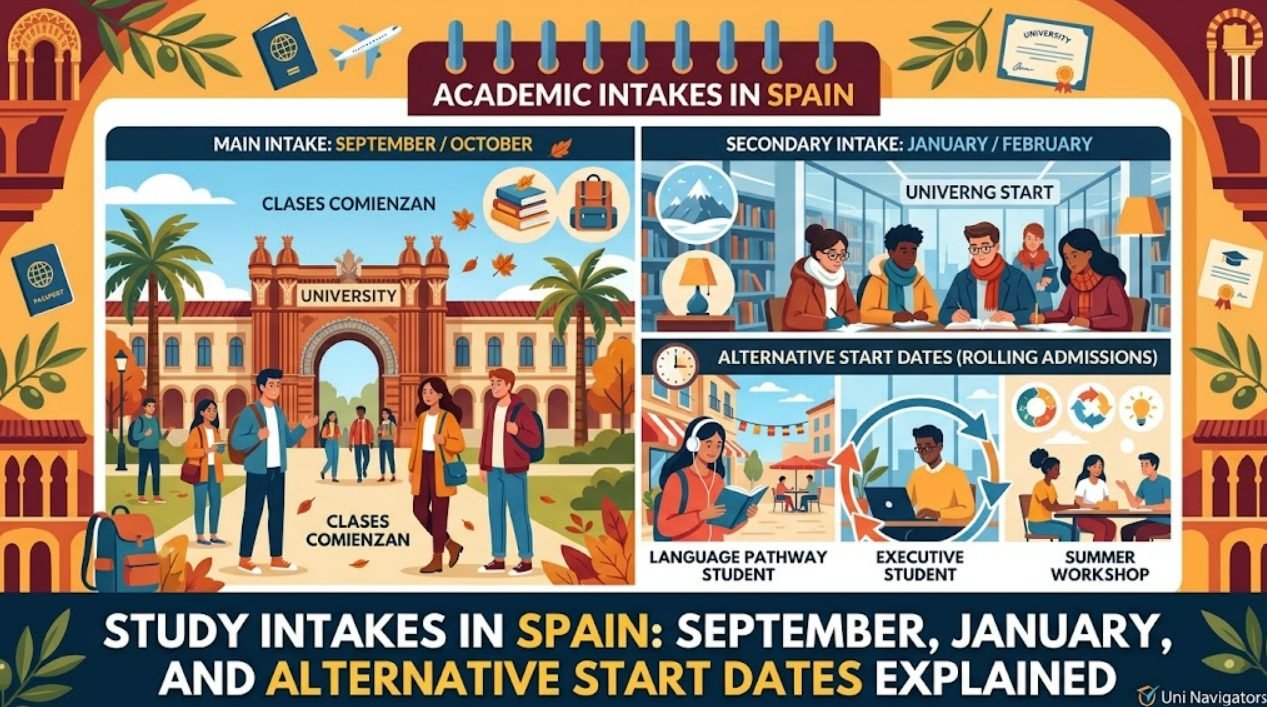
Select Your Intakes: Spanish universities primarily admit students for the Fall Intake (September/October), with applications opening between January and May. A limited number of master’s programs offer a secondary Spring Intake (January/February).
Student Visa (Type D): Requires proof of admission, medical insurance from an authorized Spanish provider, a clean criminal record check, and proof of sufficient funds (calculated based on Spain's IPREM economic indicator).
Take the Next Step with Uni Navigators
Navigating European university admissions, course equivalencies, and embassy visa appointments can be complex, but you don't have to do it alone.
At Uni Navigators, we guide students through every stage of the process:
Evaluating your profile to select the best English-taught programs in Spain.
Managing document translations and regional application portals.
Preparing comprehensive student visa files to maximize approval rates.
Ready to start your journey? Book a free consultation with a Uni Navigators education advisor today and let’s map out your path to studying in Spain.