Study in UK Without IELTS: English Language Requirements and Accepted Alternatives
The United Kingdom remains one of the most popular destinations for international students, attracting thousands of applicants every year with its world-class universities, globally recognised qualifications, and excellent career opportunities.
One of the most common questions students ask is whether it is possible to study in the UK without taking the IELTS exam.
The answer is yes. Many UK universities now accept alternative methods of proving English language proficiency. However, studying in the UK without IELTS does not mean studying without demonstrating English language ability. Universities and immigration authorities still require evidence that students can successfully study in an English-speaking academic environment.
This guide explains how international students can study in the UK without IELTS, the alternatives accepted by universities, and what students need to know before applying.
Is IELTS Mandatory for Studying in the UK?
Not always.
While IELTS remains one of the most widely accepted English language tests, many UK universities accept alternative qualifications and assessment methods. Universities can often assess English proficiency through other recognised tests, previous education in English, interviews, or pathway programmes.
The specific requirements depend on:
- The university
- The course
- The student's nationality
- Previous educational background
- Student visa requirements
Students should always check the latest requirements for their chosen university and programme.
Why Students Look for IELTS Alternatives
Many international students prefer alternatives to IELTS for several reasons.
Common reasons include:
- High test fees
- Limited test dates in some countries
- Scheduling difficulties
- Previous education completed in English
- Preference for alternative English tests
- University-specific exemptions
As a result, many institutions have introduced flexible options for demonstrating English language proficiency.
Accepted Alternatives to IELTS in the UK
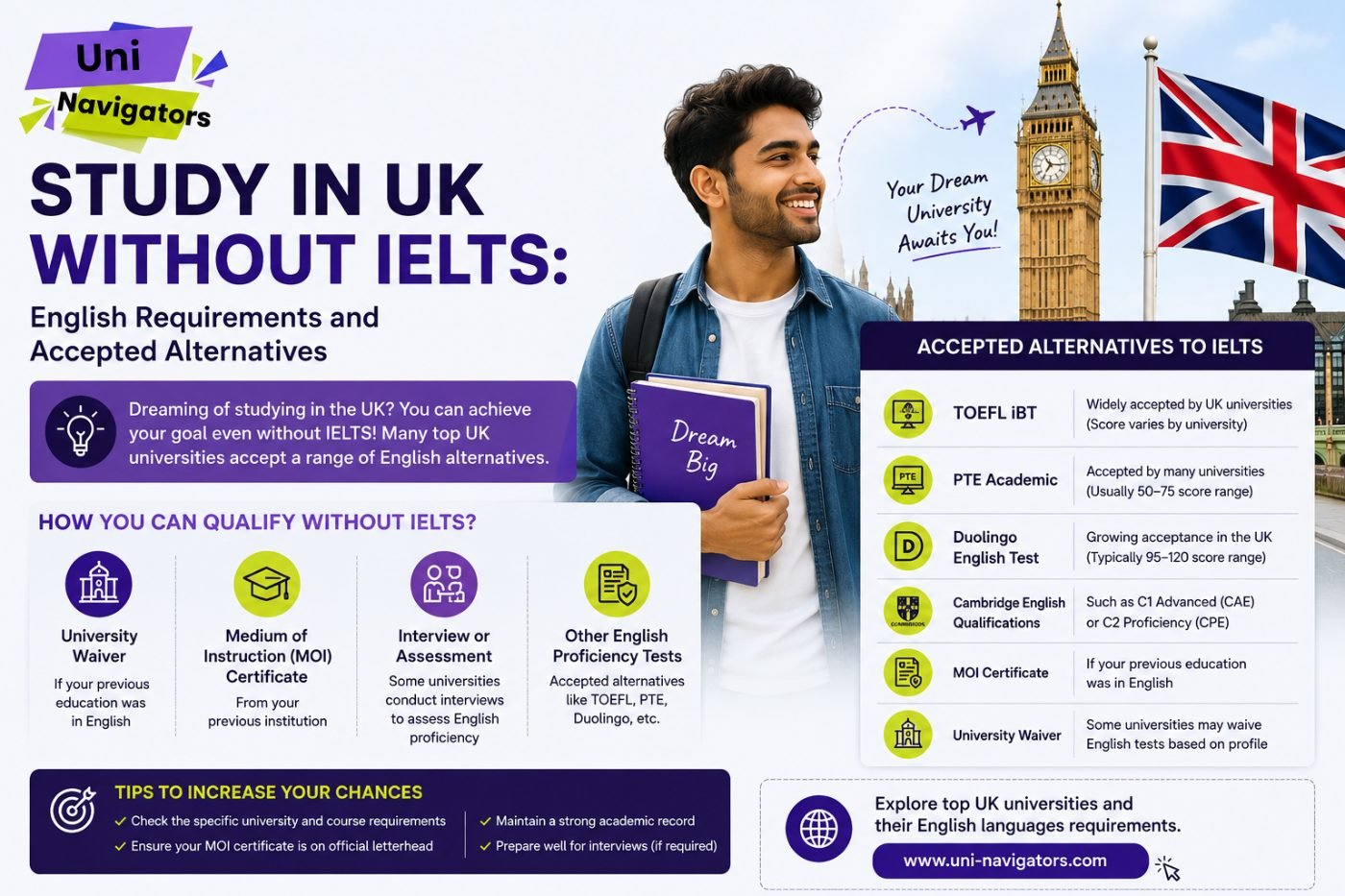
Many UK universities accept a variety of recognised English language qualifications.
1. Pearson Test of English (PTE Academic)
PTE Academic is one of the most commonly accepted alternatives to IELTS.
Benefits include:
- Computer-based testing
- Faster results
- Flexible test dates
- Wide university acceptance
Many UK universities accept PTE scores for undergraduate and postgraduate admissions.
2. TOEFL iBT
The Test of English as a Foreign Language (TOEFL) is another globally recognised qualification.
TOEFL measures:
- Reading
- Writing
- Speaking
- Listening
Many UK universities accept TOEFL as an alternative to IELTS.
3. Duolingo English Test
The Duolingo English Test has become increasingly popular among international students.
Advantages include:
- Online testing from home
- Lower cost
- Faster results
- Shorter test duration
A growing number of UK universities now accept Duolingo scores for admission purposes.
4. Cambridge English Qualifications
Several UK universities accept Cambridge English qualifications such as:
- C1 Advanced
- C2 Proficiency
These qualifications demonstrate advanced English language ability and may satisfy admission requirements.
5. LanguageCert and Other Approved Tests
Some institutions accept additional English language qualifications, including:
- LanguageCert
- Oxford ELLT
- University-specific language assessments
Acceptance varies between institutions and programmes.
Can Students Use a Medium of Instruction (MOI) Letter?
Yes, in many cases.
A Medium of Instruction (MOI) letter is issued by a school, college, or university confirming that the student's previous education was taught entirely in English.
Many UK universities may accept an MOI letter instead of IELTS, particularly for students who have completed recent qualifications in English-medium institutions.
Typical requirements may include:
- Degree completed in English
- Recent graduation
- Official institution letterhead
- Verification from the previous institution
Acceptance policies vary between universities.
Can High School English Results Be Accepted?
Some universities may consider strong English grades from secondary or higher secondary education.
Examples may include:
- High school English subject results
- A-Level English qualifications
- International Baccalaureate English
- National curriculum English grades
Requirements vary by institution and country.
University Interviews as an Alternative
Some universities conduct online interviews to assess English language ability.
During these interviews, admissions teams evaluate:
- Speaking skills
- Communication ability
- Academic readiness
- Confidence in English
Successful completion of an interview may help satisfy language requirements at certain institutions.
Pre-Sessional English Courses
Students who do not fully meet language requirements may be offered a pre-sessional English course.
These programmes help students improve:
- Academic writing
- Listening skills
- Speaking confidence
- Study skills
Successful completion often allows progression to the main degree programme. Many UK universities offer these pathways.
Foundation and Pathway Programmes
Some students choose pathway programmes that include English language preparation.
These programmes are particularly useful for students who:
- Need additional academic preparation
- Require English language support
- Do not meet direct entry requirements
Successful completion may lead to direct entry into a degree programme.
Can You Get a UK Student Visa Without IELTS?
Yes, in many cases.
The UK Student Visa does not specifically require IELTS if the university has already assessed and accepted the student's English language ability using another approved method.
The university must confirm the student's English proficiency as part of the admission process and include relevant information within the Confirmation of Acceptance for Studies (CAS).
Students should always ensure that their chosen university's language assessment method is recognised for visa purposes.
Common Documents Required When Applying Without IELTS
Students applying without IELTS may be asked to provide:
- Medium of Instruction (MOI) letter
- English language test results (PTE, TOEFL, Duolingo, etc.)
- Academic transcripts
- Degree certificates
- Personal statement
- Passport copy
- University interview records (if applicable)
Additional documents may vary depending on the institution.
Benefits of Studying in the UK Without IELTS
Students who qualify through alternative routes may benefit from:
- Reduced application costs
- Faster application processes
- More flexible admission options
- Greater accessibility
- Wider choice of English proficiency methods
However, students should ensure they genuinely possess the language skills needed to succeed academically.
Important Things to Remember
Before applying without IELTS, students should:
- Check university-specific requirements
- Confirm accepted English qualifications
- Verify visa eligibility requirements
- Ensure all supporting documents are available
- Apply early to avoid delays
English language requirements can differ significantly between universities and courses.
Final Thoughts
Studying in the UK without IELTS is possible for many international students, but proof of English language proficiency remains essential. Universities increasingly accept alternatives such as PTE Academic, TOEFL, Duolingo English Test, Cambridge English qualifications, Medium of Instruction letters, university interviews, and pre-sessional English programmes.
The key is understanding the specific requirements of your chosen university and ensuring that your English language qualifications meet both admission and visa requirements.
At Uni Navigators, we help students worldwide secure admissions to leading universities in the UK, Europe, Canada, the USA, Australia, and other top study destinations. From university applications and English language guidance to student visa support, our experienced team assists students throughout every stage of their international education journey.
Start your UK study abroad journey today with Uni Navigators.