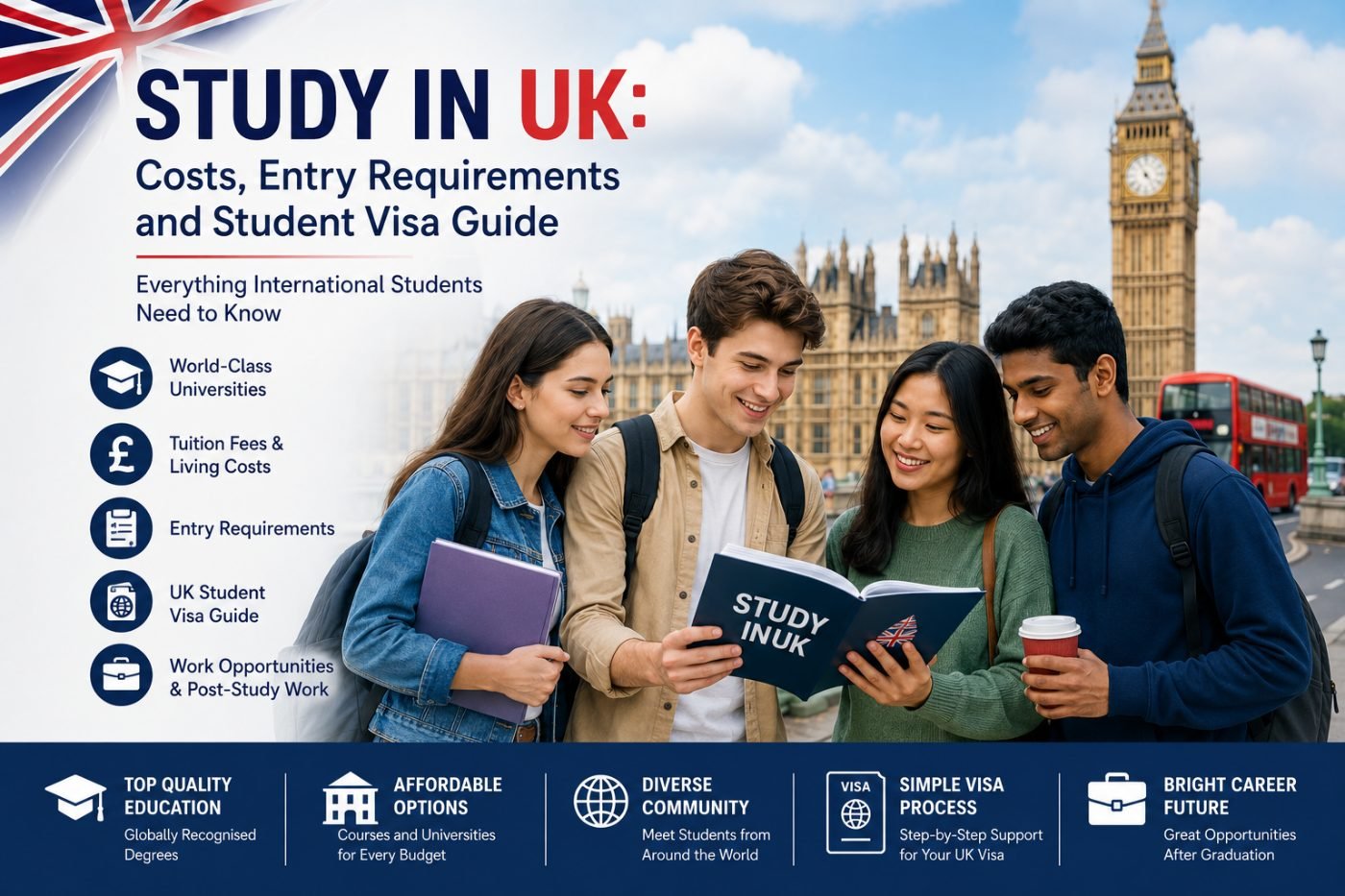
Study in UK: Costs, Entry Requirements and Student Visa Guide for International Students
The United Kingdom remains one of the world’s most popular study destinations for international students. Known for its globally recognised universities, shorter degree durations, multicultural environment, and excellent career opportunities, the UK attracts students from across the globe every year.
From undergraduate and postgraduate programmes to MBAs and research degrees, UK universities offer high-quality education and internationally respected qualifications that open doors to global career opportunities.
In this guide, we cover everything international students need to know about studying in the UK, including tuition fees, living costs, entry requirements, scholarships, and the UK student visa process.
Why Study in the UK?
The UK is home to some of the oldest and most prestigious universities in the world.
International students choose the UK because of:
- Globally recognised universities
- Shorter degree durations
- Strong academic reputation
- Multicultural learning environment
- Excellent graduate career opportunities
- Access to world-class research facilities
- Opportunity to work while studying
The UK education system is respected worldwide, making British qualifications highly valuable in international job markets.
Top Universities in the UK
The UK has many internationally ranked universities, including:
- University of Oxford
- University of Cambridge
- Imperial College London
- University College London (UCL)
- University of Edinburgh
- King’s College London
- University of Manchester
- University of Birmingham
These universities offer programmes in nearly every academic field.
Tuition Fees in the UK
Tuition fees in the UK vary depending on the university, course, and study level.
Average Tuition Fees for International Students
| Study Level | Average Annual Tuition Fees |
|---|---|
| Undergraduate Degrees | £10,000 – £25,000 |
| Postgraduate Degrees | £12,000 – £30,000 |
| MBA Programmes | £18,000 – £45,000 |
| Medicine and Dentistry | £30,000 – £60,000 |
Specialised courses such as medicine, engineering, and business may have higher tuition fees.
Living Costs in the UK
Living expenses depend on the city and lifestyle.
London is generally more expensive compared to other UK cities.
Average Monthly Living Costs
| Expense | Average Cost |
|---|---|
| Accommodation | £400 – £1,200 |
| Food and groceries | £150 – £300 |
| Transportation | £50 – £150 |
| Utilities and internet | £80 – £150 |
| Personal expenses | £100 – £300 |
Popular Affordable Student Cities
- Manchester
- Birmingham
- Leicester
- Sheffield
- Coventry
- Glasgow
These cities offer lower living costs compared to London.
Entry Requirements for UK Universities
Admission requirements vary depending on the university and programme.
Academic Requirements
Students usually need:
For Undergraduate Programmes
- High school qualifications
- A-levels or equivalent international qualifications
- Foundation programme (in some cases)
For Postgraduate Programmes
- Bachelor’s degree from a recognised institution
- Minimum GPA or equivalent academic score
English Language Requirements
Most universities require proof of English proficiency through tests such as:
- IELTS
- TOEFL
- PTE Academic
Typical IELTS requirements range from:
- 6.0 to 7.5 overall score
Some universities may waive English tests depending on previous education background.
Additional Documents
International students may also need:
- Personal statement
- Letters of recommendation
- Academic transcripts
- Passport copy
- CV or resume (for postgraduate programmes)
- Portfolio (for creative courses)
UK Student Visa Guide
International students studying in the UK usually require a Student Visa.
Who Needs a UK Student Visa?
Students from outside the UK and Ireland generally need a Student Visa for courses longer than six months.
Requirements for UK Student Visa
Students usually need:
- Confirmation of Acceptance for Studies (CAS) from a UK university
- Valid passport
- Proof of financial support
- English language proficiency proof
- Tuberculosis (TB) test results (for some countries)
- Visa application fee payment
Financial Requirements
Students must show they can financially support themselves during studies.
This typically includes:
Tuition Fees
Proof of sufficient funds for the first year of tuition fees.
Living Expenses
Students usually need to show:
- £1,483 per month for London
- £1,136 per month outside London
for up to 9 months.
UK Student Visa Application Process
Step 1: Receive CAS Letter
After accepting your university offer, the university issues a CAS letter.
Step 2: Prepare Documents
Gather financial, academic, and identification documents.
Step 3: Apply Online
Submit your visa application through the UK government website.
Step 4: Attend Biometrics Appointment
Students provide fingerprints and photographs.
Step 5: Receive Visa Decision
Processing times may vary depending on country and season.
Work Opportunities for International Students
International students in the UK are usually allowed to work part-time during studies.
Students Can Typically Work:
- Up to 20 hours per week during term time
- Full-time during holidays
Popular student jobs include:
- Retail and customer service
- Hospitality and tourism
- Administrative work
- Tutoring
- Internships
This helps students gain work experience and support living expenses.
Graduate Route Visa (Post-Study Work)
The UK Graduate Route allows eligible international students to stay in the UK after graduation to work or look for work.
Current Graduate Route Duration
- 2 years for bachelor’s and master’s graduates
- 3 years for PhD graduates
This gives students valuable international work experience after completing their studies.
Scholarships for International Students
Many UK universities offer scholarships for international students.
Popular scholarship opportunities include:
- Chevening Scholarships
- Commonwealth Scholarships
- GREAT Scholarships
- University-specific scholarships
Scholarships may cover:
- Tuition fees
- Accommodation
- Living expenses
- Research funding
Student Life in the UK
The UK offers a vibrant and multicultural student experience.
Students enjoy:
- Modern campuses and libraries
- Student clubs and societies
- Cultural diversity
- Historic cities and landmarks
- International networking opportunities
Popular student cities include:
London
Global centre for business, finance, and culture.
Manchester
Known for affordability and student life.
Edinburgh
Famous for history and academic excellence.
Birmingham
A diverse city with excellent universities.
Glasgow
Popular for friendly atmosphere and lower living costs.
Final Thoughts
The UK continues to be one of the best destinations for international students seeking world-class education, global career opportunities, and internationally recognised qualifications.
With excellent universities, shorter degree durations, strong graduate pathways, and multicultural student life, studying in the UK can provide life-changing academic and professional opportunities.
Proper planning for tuition fees, living costs, and visa requirements can help students make the most of their study abroad experience.
At Uni Navigators, we help students secure admissions to leading universities in the UK, Europe, Canada, the USA, Australia, and other top study destinations. From university applications and course selection to student visa guidance, our experienced team supports students throughout every stage of their study abroad journey.
Start your international education journey today with Uni Navigators.