
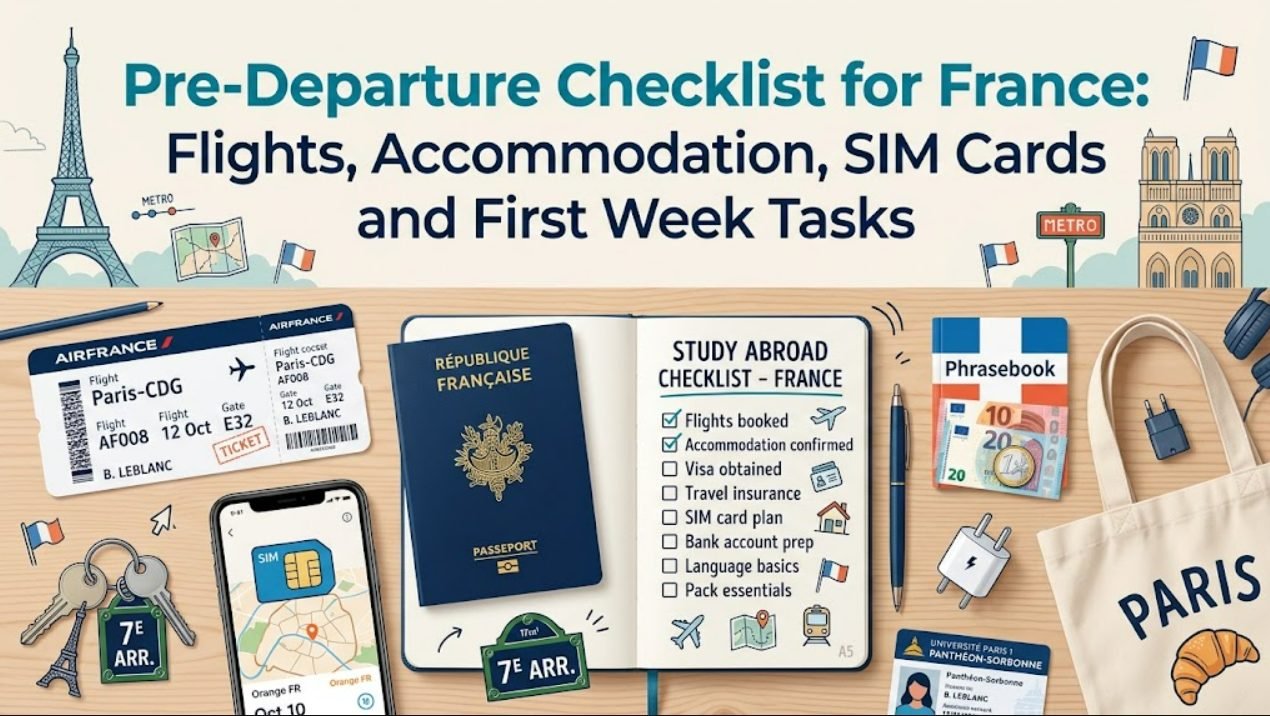
Securing your admission letter from a French university or Grande École is a major achievement, but the real transition begins long before your plane touches down at Paris-Charles de Gaulle or Lyon-Saint Exupéry.
France has a reputation for world-class education, unmatched cultural life, and heavily subsidized student living. However, it also comes with a notoriously meticulous administrative system. If you arrive unprepared, sorting out leases, residency validations, and local phone lines can quickly become overwhelming.
To ensure your move is smooth, structured, and stress-free, here is your essential pre-departure checklist for France—covering travel logistics, accommodation, connectivity, and critical first-week priorities.
Part 1: Travel & Flight Planning
Booking travel to France involves more than just hunting down the lowest airfare. Your timing dictates how smoothly your initial move-in and campus registration go.
Arrive 10 to 14 Days Before Classes Begin: Never fly in the weekend before orientation. You will need at least a week to inspect your room, collect keys, buy bedding, and register for university classes.
Avoid Sunday and Late-Night Arrivals: French retail stores, public offices, university desks, and even many private agency reception counters are closed on Sundays and shut down by 6:00 PM or 7:00 PM on weekdays. Aim for a weekday arrival (Tuesday to Thursday) between 9:00 AM and 2:00 PM.
Book Multi-Modal Rail Connections Early: If you are studying outside Paris (such as Lille, Bordeaux, Lyon, Toulouse, or Rennes), check if your flight connects directly to a high-speed TGV train straight from CDG Airport Terminal 2. Booking your SNCF train tickets 6 to 8 weeks ahead can save up to 60% compared to last-minute fares.
Luggage Strategy: Stick to standard travel allowances, but pack for variable European weather. Keep at least two changes of clothes, essential toiletries, medications, and all your physical documents in your carry-on luggage—never in checked baggage.
Part 2: Securing Accommodation Before You Board
Finding student housing in France can be competitive, particularly in major university hubs. Having a verified address or confirmed temporary stay is non-negotiable—both for your long-stay visa application and for local registrations.
Understand Your Housing Types
CROUS Residences: Publicly subsidized student housing. Extremely affordable (€200–€450/month), but priority is given to French government scholarship holders and bilateral exchange students. Places are allocated early in the spring.
Private Student Residences (e.g., Studéa, Les Estudines, Studapart partner buildings): Fully furnished rooms or studios (€500–€900/month outside Paris; €800–€1,300/month in Paris) that include Wi-Fi, laundry facilities, and utilities. They are specifically structured for international students and offer faster booking turnarounds.
Flatshares (Colocation): Renting a room in a multi-bedroom apartment. Highly popular, but usually requires signing a shared lease (bail) and presenting a complete dossier.
The French Guarantor Solution: Visale
Most French landlords legally require a guarantor (garant) earning at least three times the monthly rent within France. As an international student, you likely do not have a French relative.
Instead of paying for expensive commercial guarantee platforms, apply for Visale (visale.fr). Visale is a 100% free, state-backed rental guarantor scheme for students under 30 in France. You can apply online as soon as you have your visa, and you will receive a Visa Visale certificate that reputable landlords and student residences throughout the country readily accept.
Part 3: Phones & Connectivity: Getting Online on Day One
A local French mobile number (starting with +33) is mandatory early on. You will need it to receive SMS security verification codes from French banks, public transit apps, university portals, and delivery services.
Pre-Arrival (eSIM): If your phone supports eSIMs, set up a French plan before you leave home so your mobile data connects the moment your plane lands.
Recommended Low-Cost Providers:
Lebara France: One of the most popular choices for international students. Offers bilingual English/French support, instant eSIM activation, no binding contract (sans engagement), and does not require a French bank account to sign up.
Free Mobile: Widely known for high data allowances at low prices (typically €10–€20/month). You can buy a SIM card at self-service kiosks located in Free stores or select newsagents across French cities using a standard credit card.
Sosh or RED by SFR: Budget sub-brands of France’s major network operators (Orange and SFR). They deliver excellent coverage nationwide on no-contract monthly plans, but customer service interfaces are predominantly in French.
Part 4: The Must-Have Document Folder
French administration runs on documentation. Never rely solely on digital cloud files; bring an organized physical folder containing your originals plus at least two printed photocopies of each:
[ ] Valid Passport with Long-Stay Student Visa (VLS-TS) [ ] Official University Admission Letter / Certificat d'Inscription [ ] Birth Certificate (Legalized/Apostilled, with a certified French translation) [ ] Proof of Financial Means (Bank statements, loan letter, or scholarship certificate) [ ] Housing Certificate (Attestation d'hébergement, lease contract, or booking voucher) [ ] Proof of Health Insurance Coverage (for travel and your first weeks) [ ] At least 6 European-format passport photos (35mm x 45mm, plain light background)Part 5: Your First-Week On-The-Ground Action Plan
Your first 7 days will be a whirlwind. Tackling these tasks in the correct chronological order avoids unnecessary back-and-forth:
Arrival Days 1–3 └── Move into your accommodation & complete the "État des Lieux" (room inventory). └── Activate your French SIM card. └── Visit campus to collect your student card (Carte d'étudiant) and schedule. Arrival Days 4–5 └── Open a French bank account (Online banks like BoursoBank or traditional branches). └── Pay your CVEC fee (€103 campus fee, if not completed pre-departure) via messervices.etudiant.gouv.fr. Within 90 Days (Start in Week 1–2) └── Validate your VLS-TS visa online via the ANEF portal (administration-etrangers-en-france.interieur.gouv.fr). └── Register for French Social Security (Assurance Maladie) at etudiant-etranger.ameli.fr for free health coverage. └── Apply for CAF Housing Benefit (APL) once your lease and bank account are active.1. Complete the État des Lieux (Move-In Inventory)
When collecting your apartment or dorm keys, the landlord or building manager will conduct a thorough walkthrough checklist (état des lieux d'entrée). Note every scratch, scuff, leak, or missing item on the form before signing it. This exact document determines whether you get your security deposit refunded when you move out.
2. Open a French Bank Account
You will need a French IBAN (International Bank Account Number) to pay rent, set up utilities, receive student employment wages, and apply for government subsidies.
Many traditional branches (BNP Paribas, Société Générale, LCL) offer student packages that include mandatory student home insurance (assurance habitation).
Digital and neobanks (like BoursoBank or Revolut with a French IBAN) can be opened quickly via smartphone once you have your proof of address and student visa.
3. Validate Your VLS-TS Visa Online via ANEF
If you entered France on a Visa de Long Séjour valant Titre de Séjour (VLS-TS), your visa is not fully legal until it is validated online.
You have 3 months from arrival to complete this on the official ANEF platform (administration-etrangers-en-france.interieur.gouv.fr).
You will submit your arrival date, French address, and pay a digital tax stamp (timbre fiscal, typically €50 to €100 depending on your visa category).
Once approved, you download your Confirmation de validation de l’enregistrement de votre visa long séjour, which serves as your official French residence permit.
4. Register for French Social Security (Ameli)
Higher education students in France receive public healthcare coverage for free. Once you have your university registration certificate and French bank IBAN, submit your details at etudiant-etranger.ameli.fr. You will eventually be issued a Carte Vitale, which reimburses up to 70% of standard doctor visits and prescription medications.
5. Apply for CAF Housing Aid (APL)
France is one of the only countries in the world that provides direct monthly rent subsidies to international students through the Caisse d'Allocations Familiales (CAF). Depending on your rent, city, and income, the Aide Personnalisée au Logement (APL) can reimburse between €100 and €250+ directly toward your rent each month. Apply online at caf.fr as soon as your lease is signed and your bank account is active.
Plan Your Study Abroad Smoothly with Uni Navigators
Transitioning to a new country and academic system can be a complex journey, but you don't have to navigate it alone.
At Uni Navigators, we assist students across the globe with comprehensive end-to-end guidance:
Matching you to top-ranked, English-taught programs across France and Europe.
Structuring bulletproof visa dossiers to secure your VLS-TS without administrative delays.
Providing personalized pre-departure orientations, accommodation referrals, and document review.
Ready to start your European academic journey? Book a free consultation with an advisor at Uni Navigators today and let us help you turn your study abroad plans into reality.