When You Start in the USA Matters More Than Most Students Realise
Most international students, when they begin researching study in the United States, focus almost entirely on where they want to go and what they want to study. The question of when they want to start — and which intake actually makes sense for their situation — tends to get treated as an afterthought. Something to figure out after the university and the course have been decided.
That approach creates problems. Because in the American higher education system, the intake you choose does not just determine your start date. It shapes your application timeline, your visa schedule, your accommodation options, your social integration into campus life, and in some cases the programmes and financial aid that are actually available to you.
This guide explains how the US academic year is structured, what the September, January, and summer intakes actually look like in practice, which types of students each intake suits best, and how to build your planning around whichever start date fits your circumstances.
How the US Academic Year Is Structured
Before getting into the specific intakes, it helps to understand how American universities organise their academic year — because it is not uniform across all institutions, and the structure affects which intake options are available to you.
The Semester System
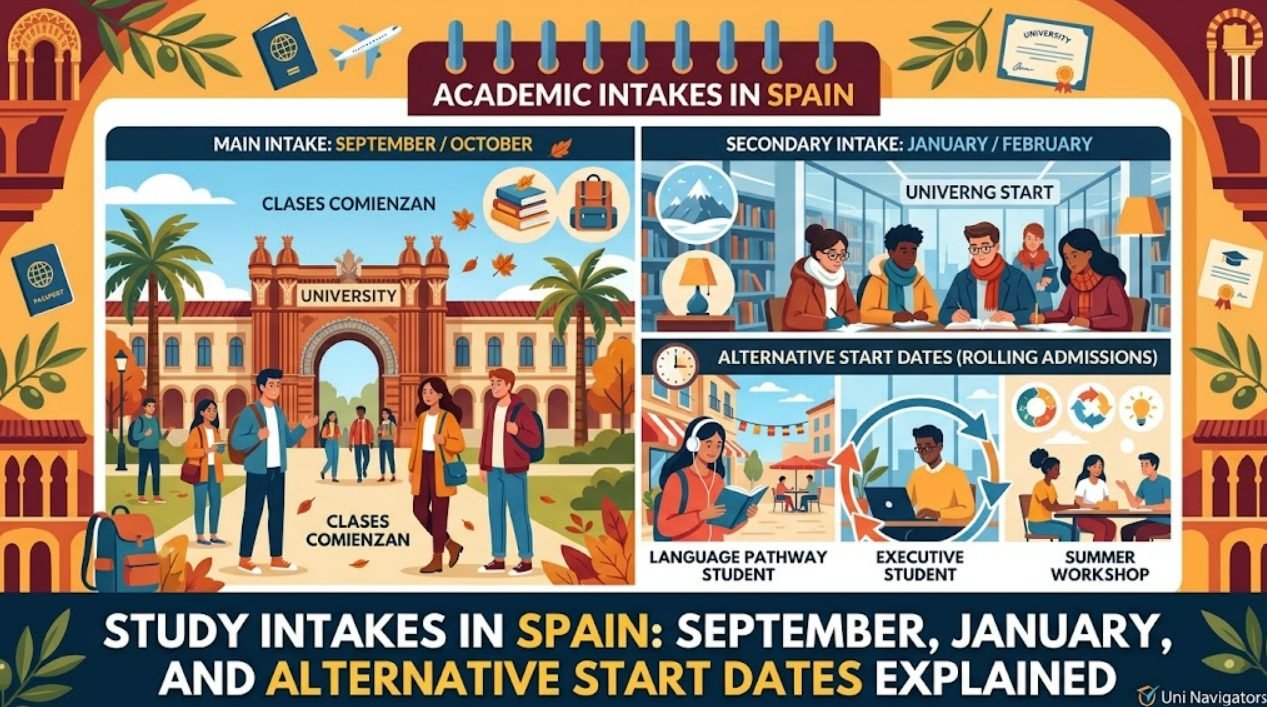
The most common academic calendar structure at American universities is the semester system, which divides the academic year into two main terms:
- Fall semester: Typically begins in late August or early September and runs through to December, ending with final examinations before the winter break
- Spring semester: Typically begins in January and runs through to May, ending with final examinations and, for graduating students, commencement ceremonies
This is the calendar structure used at the majority of America's most well-known universities, including most Ivy League institutions, large state universities, and most private colleges. If you are applying to a university on the semester system, your two main entry points are the fall semester and the spring semester.
The Quarter System
A significant minority of American universities — including Stanford University, the University of California system, the University of Chicago, and several others — use a quarter system rather than a semester system. The quarter calendar divides the academic year into three terms of approximately ten weeks each:
- Fall quarter: Typically September or October to December
- Winter quarter: Typically January to March
- Spring quarter: Typically April to June
- Summer quarter: Available at some institutions as an optional fourth term
The quarter system creates more flexibility in entry points, though the majority of students still begin in the fall quarter. It also means that courses, credits, and module structures work differently from semester-system universities — something worth understanding before you compare programmes across institutions.
The Trimester System
A small number of universities use a trimester system, which divides the year into three terms of roughly equal length. This is less common than either the semester or quarter system and tends to be found at certain law schools and professional programmes rather than across whole institutions.
Understanding which calendar system your target university uses is a basic but important piece of groundwork — and it directly determines which start dates are available to you.
The September / Fall Intake: The Primary Entry Point
What It Is
The fall intake — beginning in late August or September depending on the institution — is the primary intake for the American higher education system. It is when the academic year formally begins, when the majority of new students arrive on campus, when freshers' events and orientation programmes take place, and when the full energy of university life kicks into gear.
For the overwhelming majority of undergraduate programmes, the fall intake is the only intake. New undergraduate students at most American universities start in September. There is no alternative entry point for bachelor's degree programmes at most institutions.
At postgraduate level, the fall intake remains the primary entry point but is not always the only one. Many Master's programmes accept students in both fall and spring. A smaller number accept students at additional points in the year. PhD programmes are more varied — some admit students only in the fall, others on a rolling basis.
Why Fall Is the Preferred Intake for Most Students
Widest programme availability Every programme at every institution is available for a fall start. If you are applying for a specific, competitive, or specialist programme, the fall intake gives you access to the full range of options. Spring and summer intakes are available only at selected institutions and for selected programmes.
Strongest financial aid availability Scholarships, fellowships, teaching assistantships, research assistantships, and other forms of financial aid are almost universally allocated for the fall intake. If financial aid is a factor in your decision — and for most international students, it is — applying for the fall maximises both the quantity of aid available and the size of individual awards.
Full orientation and transition support Universities invest significantly in fall orientation programmes for new international students. Welcome weeks, campus tours, visa compliance briefings, cultural transition workshops, and social events are all structured around the fall arrival. Students who start in January or at other points in the year often miss this infrastructure and need to find their footing more independently.
Social integration Starting when the majority of your cohort starts gives you a natural social advantage. Friendships form early in a shared experience, and arriving in September means you are part of that founding group. Arriving in January means entering a social landscape that has already been partially established without you.
Academic sequencing Many degree programmes — particularly at undergraduate level — are designed to be completed in sequence, with foundational courses taken in the fall followed by more advanced material building on that foundation in the spring. Starting in September means following the intended academic sequence. Starting mid-year can create complications around prerequisites and module availability.
The Application Timeline for Fall Intake
For a September start, the general planning timeline works as follows. Specific deadlines vary by institution — always check the admissions page of each university you are targeting.
- September to October (year before): Begin researching universities and programmes. Prepare for standardised tests (SAT, ACT, GRE, GMAT) if required.
- October to November: Request school or university references. Begin drafting personal statement and supplemental essays.
- November to January: Submit applications. Early decision and early action deadlines at many selective universities fall in November. Regular decision deadlines typically fall in January.
- March to April: Receive admissions decisions. Evaluate offers and financial aid packages.
- April to May: Accept offer and pay deposit. Apply for university accommodation.
- May to June: Begin F-1 visa application — pay SEVIS fee, complete DS-160, schedule interview.
- June to August: Attend visa interview. Receive visa. Book travel.
- Late August to September: Arrive in the United States. Attend orientation. Begin studies.
The January / Spring Intake: A Genuine Alternative, Not a Consolation
What It Is
The spring intake — beginning in January at most semester-system universities — is the secondary entry point into the American higher education system. It is available at a meaningful number of institutions, particularly at postgraduate level, and it represents a genuine option rather than simply a fallback for students who missed the fall deadline.
That said, it is important to be clear-eyed about what the spring intake offers and what it does not. It is not the same as the fall intake in terms of programme availability, financial aid, or the richness of the arrival experience. For students in the right circumstances, it is an excellent choice. For students who can feasibly wait for the fall, the fall is usually the stronger option.
Who the January Intake Suits Best
Students who missed the fall application cycle The most common reason students consider a January start is that they became ready to apply — academically, financially, or practically — after the fall application window had closed. Rather than waiting a full year for the next fall intake, the January start allows them to begin their studies six months earlier.
Students who need more time to prepare Some students use the gap between a late fall and the following January to strengthen their application — retaking a standardised test, completing a language requirement, gathering better references, or improving their GPA in a final semester of existing study. A January start effectively creates a short preparation window that a direct fall application would not allow.
Students transferring from another institution Students who have been studying at another American institution — perhaps completing a two-year associate degree at a community college — and are transferring to a four-year university sometimes find that January is the most natural transition point depending on when they complete their associate programme.
Postgraduate students in specific fields Certain postgraduate programmes, particularly in business, education, and some social science disciplines, actively recruit for January starts and have equivalent programme structures available for both fall and spring entrants. For students in these fields applying to institutions with strong January cohorts, the spring intake can be fully equivalent to fall.
What to Watch Out For With a January Start
Reduced programme availability Not every programme accepts students in January. Competitive, specialist, or professionally accredited programmes are more likely to be fall-only. Before committing to a January start, confirm explicitly with your target institutions that the programme you want to study is available for spring entry.
Limited financial aid This is the most significant practical disadvantage of the January intake. The majority of scholarship budgets, assistantship allocations, and fellowship awards are distributed in the fall admissions cycle. By January, many funding packages have already been committed. Students starting in January are more likely to be self-funded or to receive smaller aid packages than those who start in September.
Missing fall orientation As noted above, the orientation infrastructure that universities build for international students is primarily fall-focused. January arrivals typically receive a scaled-down version of this support, which can make the early weeks of study feel less structured and less socially connected.
Mid-year graduation Students who start their degree in January will, if they follow a standard academic timeline, graduate in December rather than in May or June. December graduations are smaller, less celebrated events at most American universities, and some employers time their graduate recruitment cycles around the May graduation season — meaning January-start students may need to plan their job applications differently.
The Application Timeline for January Intake
For a January start, the planning timeline generally runs as follows:
- April to May (year before): Begin researching programmes available for January entry. Confirm availability with target institutions.
- June to July: Prepare application documents — transcripts, personal statement, references, test scores.
- August to September: Submit applications. Most January intake deadlines fall between September and November.
- October to November: Receive admissions decisions. Accept offer and pay deposit.
- November: Receive I-20 from university. Pay SEVIS fee. Complete DS-160.
- November to December: Schedule and attend F-1 visa interview. Arrange accommodation.
- Late December to January: Travel to the United States. Attend orientation. Begin studies.
The compressed nature of this timeline — particularly between receiving your offer, completing your visa application, and travelling — is one of the genuine challenges of the January intake. Everything happens faster, and there is less room for delays. Factor this in when deciding whether January or the following September is the more practical choice for your specific situation.
The Summer Intake: Niche but Genuinely Useful
What It Is
The summer intake — which typically begins in May or June — is the most limited entry point in the American higher education system. It is not a mainstream intake in the way that fall and spring are, and it is not available at most universities for most programmes.
Where summer entry does exist, it tends to fall into a few specific categories:
- Intensive English language programmes — Many American universities and language schools offer intensive English courses during the summer that can serve as a pathway into a degree programme starting in the fall. These are common entry points for students who need to improve their English proficiency before beginning academic study.
- Summer session courses — Most universities offer summer session courses — accelerated versions of regular academic modules that run over six to ten weeks during the summer months. Existing enrolled students commonly use these to catch up on credits, get ahead in their programme, or explore electives outside their main field.
- Pathway and foundation programmes — Some universities offer summer-entry pathway programmes designed specifically for international students who need additional academic preparation before beginning a full degree.
- Specific graduate programmes — A small number of professional graduate programmes — particularly certain MBA, public health, and education programmes — use a May or June start date as their primary intake rather than fall or spring.
Who Might Consider a Summer Start
The summer intake is worth considering in specific and relatively narrow circumstances:
- You need to complete an English language or academic pathway programme before beginning your degree, and doing so in the summer means you can start your full degree in the following fall rather than waiting a full year
- You have been accepted into a specific graduate programme that begins in May or June
- You are an existing F-1 student who wants to accelerate your studies by taking summer session credits
For most prospective international students beginning a degree programme from scratch, the summer intake is not a primary consideration. It is a niche entry point with specific applications rather than a mainstream alternative to fall or spring.
Comparing the Three Intakes: A Practical Summary
Understanding the differences between intakes side by side helps in making a clear decision. Here is a direct comparison across the factors that matter most to international students:
Programme availability Fall intake offers the widest range — every programme at every institution. Spring intake offers a meaningful but reduced selection, primarily at postgraduate level. Summer intake is very limited and largely restricted to language, pathway, and specific professional programmes.
Financial aid and scholarships Fall intake is by far the strongest for financial aid. The large majority of scholarships, assistantships, and fellowships are allocated in the fall admissions cycle. Spring intake typically offers less aid. Summer intake offers very little institutional aid for new students.
Orientation and transition support Fall intake comes with the most comprehensive orientation infrastructure for international students. Spring intake offers reduced support. Summer intake orientation varies widely by programme.
Social integration Fall intake is the most socially natural entry point — you arrive with the majority of your cohort. Spring intake means entering an established social environment. Summer intake is a small, specific cohort with limited general campus social life.
Visa processing timeline Fall intake allows the most time for visa preparation — typically four to six months between offer and travel. Spring intake is more compressed — typically two to three months. Summer intake timeline varies but can be similarly compressed.
Graduation timing Fall intake typically leads to May or June graduation — the main commencement season. Spring intake leads to December graduation. Summer intake graduation timing depends on the programme duration.
How to Decide Which Intake Is Right for You
Rather than defaulting to the fall intake simply because it is the most common, or choosing the January intake simply because your application is not quite ready, think through the following questions deliberately.
Is your target programme available for the intake you are considering? This is the first and most fundamental question. If the programme you want to study is only offered in the fall, the decision is made for you. Confirm availability before investing time in an application for an intake that may not be open to you.
Is your application genuinely ready? A strong fall application submitted in January is almost always better than a rushed fall application submitted in November. If you need more time — to improve your test scores, strengthen your personal statement, or gather better references — taking that time and applying for the next available intake will produce a better outcome than submitting an application before it is ready.
How important is financial aid to your ability to attend? If financial aid is essential rather than simply desirable, the fall intake is the significantly stronger option. A spring start with minimal aid may cost you more over the full duration of your degree than waiting for the fall and securing a meaningful scholarship.
How does your English language preparation align? If you need to complete an English language programme or improve your test scores before beginning your degree, a summer entry into a language pathway followed by a fall degree start may be the most efficient route. Map your language preparation timeline against the intake dates before deciding.
What is your visa processing situation? Students from countries where F-1 visa interviews have long wait times — currently including several South Asian, African, and Middle Eastern countries — need to factor processing time into their intake decision. If interview wait times in your country are running at twelve weeks or more, a January start may require you to schedule your interview almost immediately after receiving your offer. The fall intake gives you more time to manage this.
Key Dates and Deadlines to Know
While specific dates vary by institution, the following general schedule gives a useful framework for planning:
Fall / September Intake
- Application period: August to January (early action/decision: October to November; regular decision: December to January)
- Admissions decisions: March to April
- Enrolment confirmation deadline: May 1st (universal deadline for most undergraduate institutions)
- Orientation and arrival: Late August to early September
Spring / January Intake
- Application period: June to November
- Admissions decisions: October to December
- Enrolment confirmation: November to December
- Orientation and arrival: Early to mid-January
Summer Intake
- Application period: January to April (for most summer programmes)
- Admissions decisions: February to May
- Arrival: May to June
Always verify the specific deadlines published on the admissions pages of your target institutions. Application deadlines for international students sometimes differ from domestic deadlines, and missing a deadline by even one day at a rolling-admissions institution can push your application to the next available intake.
A Note on Rolling Admissions
Some American universities — particularly at postgraduate level — operate on a rolling admissions basis rather than setting fixed application deadlines. Rolling admissions means that applications are reviewed and decisions made as applications are received, rather than in a single batch after a closing date.
At rolling admissions institutions, applying early gives you a genuine advantage. Not only are there typically more places available earlier in the cycle, but financial aid pools are often depleted as the cycle progresses. The advice is simple: do not wait until the last possible moment to apply to a rolling admissions institution. Submit your application as soon as it is strong and complete.
Planning Your Application Around the Right Intake
Whichever intake you are targeting, the single most important piece of advice is to start planning earlier than feels necessary. Every stage of the process — preparing your application documents, sitting standardised tests, requesting references, completing your DS-160, scheduling your visa interview, and arranging accommodation — takes longer than most students expect when they first look at it from a distance.
Students who begin planning twelve to eighteen months before their intended start date have time to course-correct if something does not go to plan. Students who begin planning six months out are gambling that everything goes smoothly. In a process with as many sequential steps as a US university application and F-1 visa, something almost always takes longer than expected somewhere along the way.
Build your timeline with enough buffer to absorb a delay without it cascading into a missed start date — and if you are unsure how much time is realistic, talk to someone who has guided students through the process before.
How Uni Navigators Can Help
Choosing the right intake is one piece of a much larger puzzle. Knowing which universities to apply to, how to position your application competitively, how to manage the visa timeline, and how to plan your finances around a study abroad programme are decisions that benefit from experienced guidance — particularly when you are navigating a system as large and varied as American higher education from thousands of miles away.
At Uni Navigators, we work with students from Pakistan, India, Nigeria, Kenya, Bangladesh, the UAE, Saudi Arabia, Egypt, and many other countries who are planning to study in the United States. We help you identify the right intake for your specific situation, build your application timeline around it, and support you through every stage from initial research to arrival on campus.
Our team offers support with:
- Intake planning and application timeline development
- University and programme shortlisting for your target intake
- Full application preparation — personal statement, essays, references, and test preparation guidance
- F-1 visa file preparation and interview coaching
- Financial aid and scholarship application support
- Pre-departure planning and arrival guidance
Book a free consultation with Uni Navigators today and get a clear, personalised plan for your US study application — starting with the right intake for you.