When You Start in New Zealand Matters More Than Most Students Think
Choosing a university in New Zealand and deciding which programme to study are the decisions that get most of the early attention. When to start tends to be treated as an administrative detail — something to sort out once the bigger questions are settled.
That's a mistake. In New Zealand, the intake you choose shapes far more than just your arrival date. It affects your application timeline, your student visa schedule, your access to scholarships and orientation support, the social experience of your first semester, and in some cases which programmes are actually available to you. A student who chooses the wrong intake for their circumstances doesn't just face minor inconvenience — they can find themselves in a difficult position academically or financially that could have been avoided with a clearer picture from the outset.
This guide explains how New Zealand's academic year is structured, what the main intakes look like in practice, who each intake suits, and how to build your planning around whichever start date genuinely fits your situation.
How the New Zealand Academic Year Is Structured
New Zealand's academic year differs from the Northern Hemisphere model, which surprises some international students who are accustomed to a September start. Understanding the calendar from the beginning prevents a lot of confusion later.
Semester System at Universities
New Zealand's eight universities operate on a two-semester system:
Semester One — typically beginning in late February or early March and running through to June, with final examinations in June.
Semester Two — typically beginning in July and running through to November, with final examinations in November.
This calendar is shaped by New Zealand's position in the Southern Hemisphere, where summer falls in December and January and the main academic year begins after summer ends. The result is a calendar that runs roughly six months offset from the UK, Canada and Ireland, and broadly similar in structure (though shifted by about a month) compared to Australia.
Between semesters, universities have formal break periods that are relevant for student visa work rights — students can work full-time during these scheduled breaks, which typically include the summer period (December through February) and the inter-semester break (June to July).
Trimester and Quarter Systems
A small number of New Zealand universities and polytechnics operate on trimester or quarter systems rather than semesters. The Open Polytechnic of New Zealand, for example, has a more flexible intake structure suited to its distance learning model. Institutions using trimester or quarter systems typically offer more intake points throughout the year, though the majority of degree-level study in New Zealand remains on the standard two-semester calendar.
Foundation and Pathway Programmes
Foundation and pathway programmes — often offered by providers affiliated with universities — generally have more flexible intake structures than university degree programmes, with some offering both a February and a July start, and occasionally additional intakes aligned with specific university admission cycles. Students completing a foundation programme before entering a degree need to plan their intake choice with both the foundation programme and the subsequent degree entry point in mind.
The February / Semester One Intake: New Zealand's Primary Entry Point
What It Is
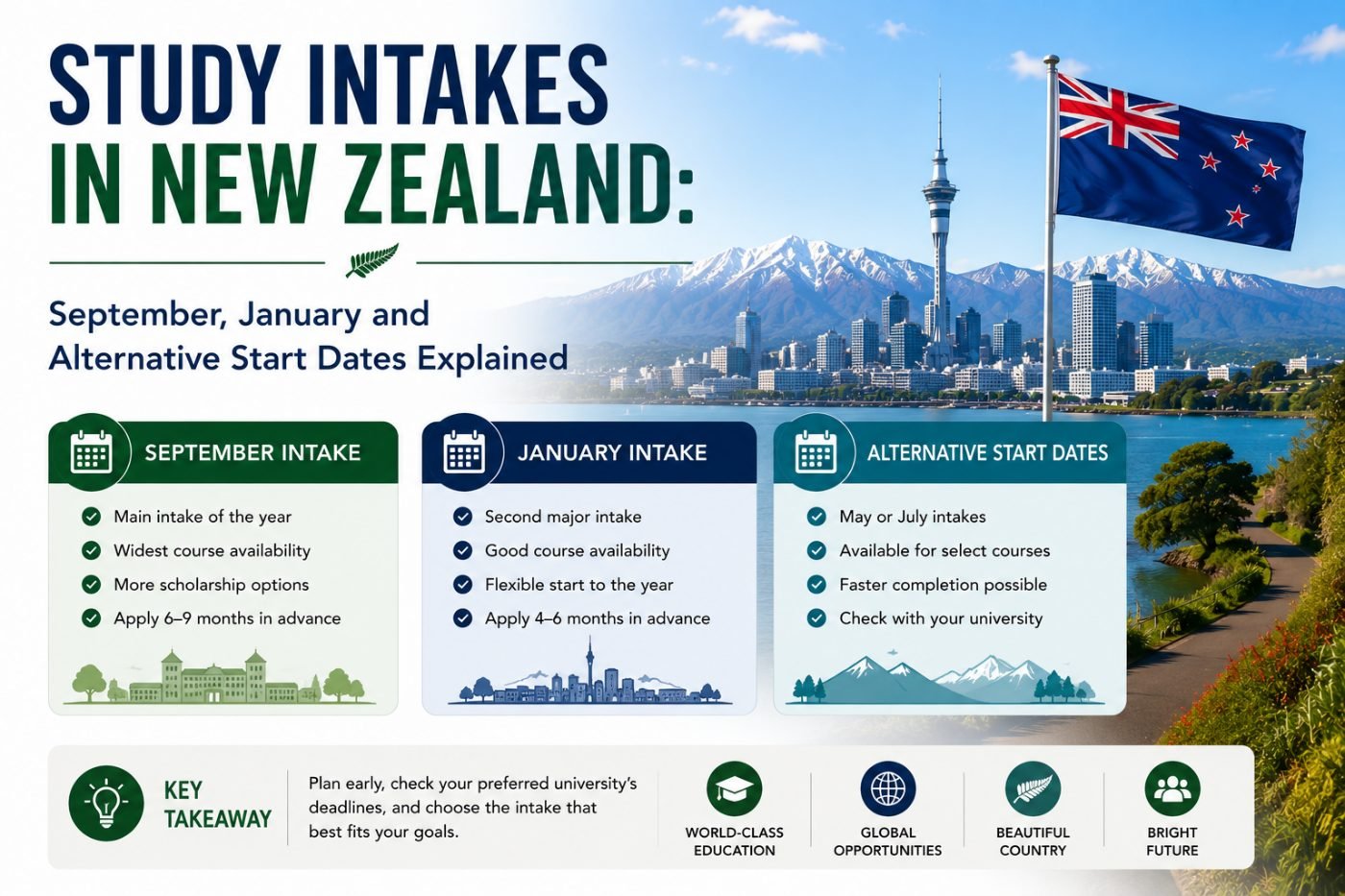
The Semester One intake — beginning in late February or early March — is the primary entry point into New Zealand's university system. It is when the academic year formally begins, when the majority of new students arrive, when university orientation programmes run, and when the full social and academic infrastructure of campus life is at its most active.
For undergraduate programmes in particular, February is frequently the only intake. Many bachelor's degree programmes are designed to run in sequence from Semester One, with core first-year papers taught in that semester as prerequisites for later study. Starting mid-year into such a programme creates immediate sequencing complications that most universities prefer to avoid.
At postgraduate level, February remains the dominant intake but is not always the only one — many taught Master's programmes accept students in both Semester One and Semester Two. Research degrees, including PhD programmes, can generally be started at any point in the year, though most supervisors and departments prefer February starts for practical administrative and cohort-building reasons.
Why February Is the Right Choice for Most Students
Maximum programme availability. Every programme at every institution is open for a February start. If you're applying for a competitive, specialist, or professionally accredited programme — anything in health sciences, engineering, law, or architecture — February is almost certainly the only option. No assumptions should be made that your preferred programme offers July entry without confirming this directly.
Best access to scholarships. Institutional scholarships, government awards, and most external funding are assessed for Semester One entry. By the time July applications are being processed, many scholarship budgets have already been committed. For students for whom financial aid is a genuine consideration — and for most international students, it is — February entry provides meaningfully stronger access to available funding.
Full orientation support. New Zealand universities invest significantly in orientation infrastructure for Semester One arrivals — international student welcome events, campus tours, academic orientation sessions, health and wellbeing briefings, and social activities designed to help new students settle in quickly. Students who arrive in July often find a stripped-down version of this support and need to establish themselves more independently.
Natural social integration. Starting when the majority of your cohort starts gives you a genuine social advantage. The friendships and study networks that form in the early weeks of February persist throughout a programme. Arriving in July means entering an environment that's been running without you for four months — entirely manageable, but meaningfully more effort.
Optimal student visa timeline. A February start gives international students a generous processing window — typically five to seven months between receiving an offer and the programme start date for students who apply early. This buffer comfortably accommodates standard immigration processing times and leaves room for any delays without cutting into the programme start.
The Application Timeline for February Intake
The following is a general planning framework for a February start. Specific deadlines vary by institution and programme — always confirm dates directly with each university.
March to May (year before): Begin researching institutions and programmes. Check entry requirements and language thresholds. Confirm scholarship deadlines, which often precede general application deadlines.
May to July: Register for and sit required English language tests if not already completed. Request academic references with generous lead time.
August to October: Submit applications. Most New Zealand universities process applications on a rolling basis — earlier applications receive earlier decisions, which is particularly relevant for scholarship consideration.
October to November: Receive offers. Accept your preferred offer, pay the required tuition deposit or first instalment, and receive your Offer of Place — the document that enables your student visa application.
November to December: Submit student visa application as soon as your Offer of Place and tuition payment receipt are in hand. Arrange health insurance and complete any required medical examination.
December to January: Receive student visa. Book travel. Confirm accommodation.
Late February: Arrive in New Zealand. Attend international student orientation. Begin studies.
The July / Semester Two Intake: A Genuine Alternative for the Right Student
What It Is
The Semester Two intake — beginning in July — is the secondary entry point into New Zealand's university system. It's more genuinely available than most students initially assume, particularly at postgraduate level, at some institutions for certain undergraduate programmes, and across the polytechnic and private training establishment (PTE) sector.
That said, it's important to be honest about what the July intake offers and what it doesn't. For many undergraduate programmes, July entry simply isn't available. For most scholarship opportunities, July applicants are working with a reduced pool. And the orientation and social infrastructure in July, while functional, is a quieter and less fully resourced version of what runs in February.
For students in the right circumstances, July is a genuinely useful option. For students who could feasibly wait for February and whose programme is available for both, February is almost always the stronger choice.
Who the July Intake Suits
Students who missed the February application cycle. The most common and most legitimate reason for a July start is simply that a student became ready to apply — academically, financially, or practically — after the February window had effectively closed. Rather than waiting a full year for the next February intake, July allows them to begin six months earlier, provided their chosen programme accepts mid-year entry.
Students who need additional preparation time. Some students use the gap between a missed February and the following July to strengthen their application — retaking an English language test, waiting for final degree results, gathering better references, or completing a short bridging course. July effectively creates a preparation window that a direct February application wouldn't have allowed.
Postgraduate students in flexible programmes. Many taught Master's programmes, research programmes, and some specialist postgraduate courses actively welcome July applications with genuinely equivalent entry provisions. For students in these programmes at universities that manage July cohorts well, the intake experience can be broadly comparable.
Research degree students starting with a supervisor. PhD and research Master's students often start their programme when their supervisor is ready to take them on rather than at a fixed institutional intake point. While February is preferred administratively, July (or indeed other times of year) starts are routine for research students whose supervisors are available and funded.
What to Watch Out For With July Entry
Reduced programme availability. This is the most important practical limitation. Many undergraduate programmes — and some postgraduate ones — are February-only. Before committing to a July start, confirm explicitly with each target institution that your specific programme accepts mid-year entry. A general "the university accepts July applications" does not mean every programme within that university does.
Narrower scholarship window. Most institutional scholarships are processed for February entry. Students applying for July face a reduced pool of available funding, and some scholarships have already been allocated by the time July applications are reviewed. Students for whom a scholarship would materially affect affordability should factor this into the decision between July and waiting for February.
Compressed student visa timeline. The July intake requires a more compressed visa processing schedule than February — typically two to three months between receiving an offer and the programme start date. For students in countries where New Zealand student visa processing times are extended, this timeline can become genuinely tight. Any delays in providing complete documentation, completing a required medical examination, or obtaining a police certificate can cascade into a near-miss on the start date.
Smaller orientation cohort. July orientation events exist at most New Zealand universities, but they're smaller, shorter, and less resourced than February orientation. International students arriving in July need to be slightly more self-directed in establishing themselves on campus.
December graduation. Students who begin their programme in July will, if they follow a standard academic timeline, complete their degree in November rather than in June. This doesn't affect the quality of the qualification, but it does affect the timing of the Post-Study Work Visa application and the start of your New Zealand work experience accumulation — a consideration for students with specific immigration timelines in mind.
The Application Timeline for July Intake
December to January: Research programmes available for July entry — confirm with each target institution that your specific programme accepts mid-year applicants.
January to March: Prepare application documents. Submit applications. Most July intake deadlines at New Zealand universities fall between March and May.
March to April: Receive offers. Accept your preferred offer. Pay tuition deposit.
April to May: Receive your Offer of Place. Submit student visa application immediately — the July timeline leaves less buffer than February, and any delays in the visa process can be costly.
May to June: Receive student visa. Book travel. Confirm accommodation.
Early July: Arrive in New Zealand. Attend orientation. Begin studies.
The compressed nature of this timeline — particularly in the two months between offer acceptance and programme start — is one of the genuine practical challenges of July entry. Everything moves faster, and there's less margin for the kinds of delays that are routine but manageable for February applicants.
Research Degree Starts: A Different Calendar Entirely
For PhD and Master's by Research students, the concept of a fixed intake is less relevant than for coursework students. Research degree starts in New Zealand are, in practice, driven by supervisor availability, research funding cycles, and the individual circumstances of the supervisory relationship — rather than a fixed institutional calendar.
Most supervisors and departments have an administrative preference for February or July starts that aligns with the semester system, but research students starting at other times of year are not unusual, and the process of applying — identifying a supervisor, making contact, developing a research proposal, and submitting a formal application — can begin at any time.
The key practical point for research students is that securing a supervisor's informal agreement before submitting a formal application is standard practice in New Zealand, and the start date is often negotiated as part of that conversation rather than fixed by an institutional deadline. Building this into your planning timeline is important — don't assume you can submit a research degree application and expect to start in the next intake without prior supervisor contact.
The PhD domestic fee policy in New Zealand — where international PhD students pay domestic-level tuition fees at most universities — is not intake-dependent. It applies regardless of whether you start in February, July, or any other month.
Polytechnic and Private Training Establishment Intakes
New Zealand polytechnics and PTEs — including institutions like Ara Institute of Canterbury, Whitireia, WelTec, Unitec, and NMIT — generally offer more intake flexibility than universities, with some institutions offering monthly or quarterly starts for popular programmes.
For students whose target programme is at a polytechnic or PTE rather than a university, the range of available start dates is typically broader, and the advice about being locked into a February or July start is less absolute. That said, the considerations around programme availability, scholarship access, and visa processing still apply — and students at polytechnics and PTEs should confirm the specific intake options for their chosen programme rather than assuming general institutional flexibility extends to their course.
Post-Study Work Visa eligibility for polytechnic and PTE graduates is also an important consideration. Not all programmes and institutions offer the same PSWV entitlement as New Zealand universities — confirm your specific course's eligibility with Immigration New Zealand guidance before enrolling.
How Study Permit Processing Times Affect Your Intake Choice
New Zealand student visa processing times vary by country and by time of year, and they're an important practical input into intake planning that's worth building into your decision early rather than treating as an afterthought.
Immigration New Zealand publishes estimated processing times on its website — check these for your specific nationality before finalising your intake choice, not after.
For February intake applicants: a student who submits a visa application in November or December typically has ample time for standard processing before a late February programme start, even allowing for some delay.
For July intake applicants: a student who submits a visa application in May has a much smaller buffer before a July start date. If processing takes longer than the published estimate — as it periodically does during high-volume periods — arriving for the programme start can become genuinely uncertain.
The practical implication: for students in countries where visa processing times tend to be longer — South Asia, parts of Africa, and the Middle East have all experienced extended processing periods at various points — the February intake provides meaningfully more resilience to processing delays than the July intake.
Choosing the Right Intake: A Decision Framework
Rather than defaulting to an intake because it seems most common, or choosing July simply because your application isn't quite ready for February, work through the following before finalising your timeline.
Is your target programme available for the intake you're considering? This is the first and most important question. Confirm directly with your target institution — not from general programme listings — whether your specific programme accepts students at your intended intake. If it doesn't, the decision is made for you.
Is your application genuinely ready? A strong February application submitted in October or November is almost always better than a rushed February application submitted at the last minute to make a deadline. If you need more time — to improve your English score, finalise transcripts, or gather better references — taking that time and applying for the next available intake will produce a better outcome.
How does student visa processing time in your country affect your timeline? Check current Immigration New Zealand processing times for your nationality before committing to an intake, particularly if you're considering July.
How important is scholarship access to your financial plan? If institutional scholarships materially affect your affordability, February is the stronger option.
What are your post-graduation immigration goals? For students planning to use the Post-Study Work Visa and pursue residence pathways, graduation timing relative to your immigration plan matters. February starters graduate in November; July starters graduate in June the following year. Understanding how this affects the timing of your PSWV application and subsequent immigration steps is useful context before choosing an intake.
How Uni Navigators Can Help
Choosing the right intake is one of those decisions that seems administrative but has genuine downstream consequences — for your application timeline, your scholarship access, your visa processing window, and ultimately the smoothness of your first weeks in New Zealand.
At Uni Navigators, we work with students from Pakistan, India, Nigeria, Bangladesh, Kenya, the UAE, Saudi Arabia, Egypt and many other countries who are planning to study in New Zealand. We help you identify the intake that genuinely fits your situation — not just the one that's most common — and build your full application and visa timeline around it from day one.
Our team supports you with:
- Intake planning based on your programme, visa timeline, and financial situation
- University and programme shortlisting with intake availability confirmed
- Full application preparation including personal statement and supporting documents
- Student visa preparation and documentation support
- Scholarship deadline mapping for your target intake
- Pre-departure planning and arrival support
Book a free consultation with Uni Navigators today and get a clear, personalised plan for your New Zealand study application — starting with the intake that genuinely works for you.