Why New Zealand Is Worth a Closer Look for Pakistani Students
New Zealand doesn't typically come up first when Pakistani families begin researching study abroad options. The UK, Canada, and Australia dominate early conversations, and New Zealand tends to enter the picture later — often when students who've started comparing costs, visa complexity, and post-study options more carefully begin to notice something that wasn't initially obvious.
New Zealand has eight universities, all publicly funded, all ranked globally. The visa process is straightforward by the standards of most comparable destinations. The country's post-study work visa gives graduates up to three years of open work rights after completing their degree — no employer sponsorship required. And New Zealand's skilled migration system, for graduates who work in the right fields, has pathways toward residence that are genuinely more accessible than equivalents in many larger countries.
For Pakistani students specifically, there are a few additional points worth noting from the outset. Pakistani academic qualifications — including O-Levels, A-Levels, and degrees from HEC-recognised institutions — are understood and accepted by New Zealand universities, with a well-established process for evaluating them against New Zealand standards. Pakistan and New Zealand have a functional bilateral relationship, and the student visa process from Pakistan, while requiring careful preparation, is manageable and predictable. And New Zealand's growing South Asian community — particularly in Auckland — means Pakistani students arrive into an existing community of people who share cultural and culinary references, which eases the transition considerably.
This guide covers everything a Pakistani student needs to know before applying: what studying in New Zealand costs, how the student visa process works from Pakistan, which scholarships are available, and what steps to follow to put together a strong application.
Understanding What New Zealand's Universities Actually Cost
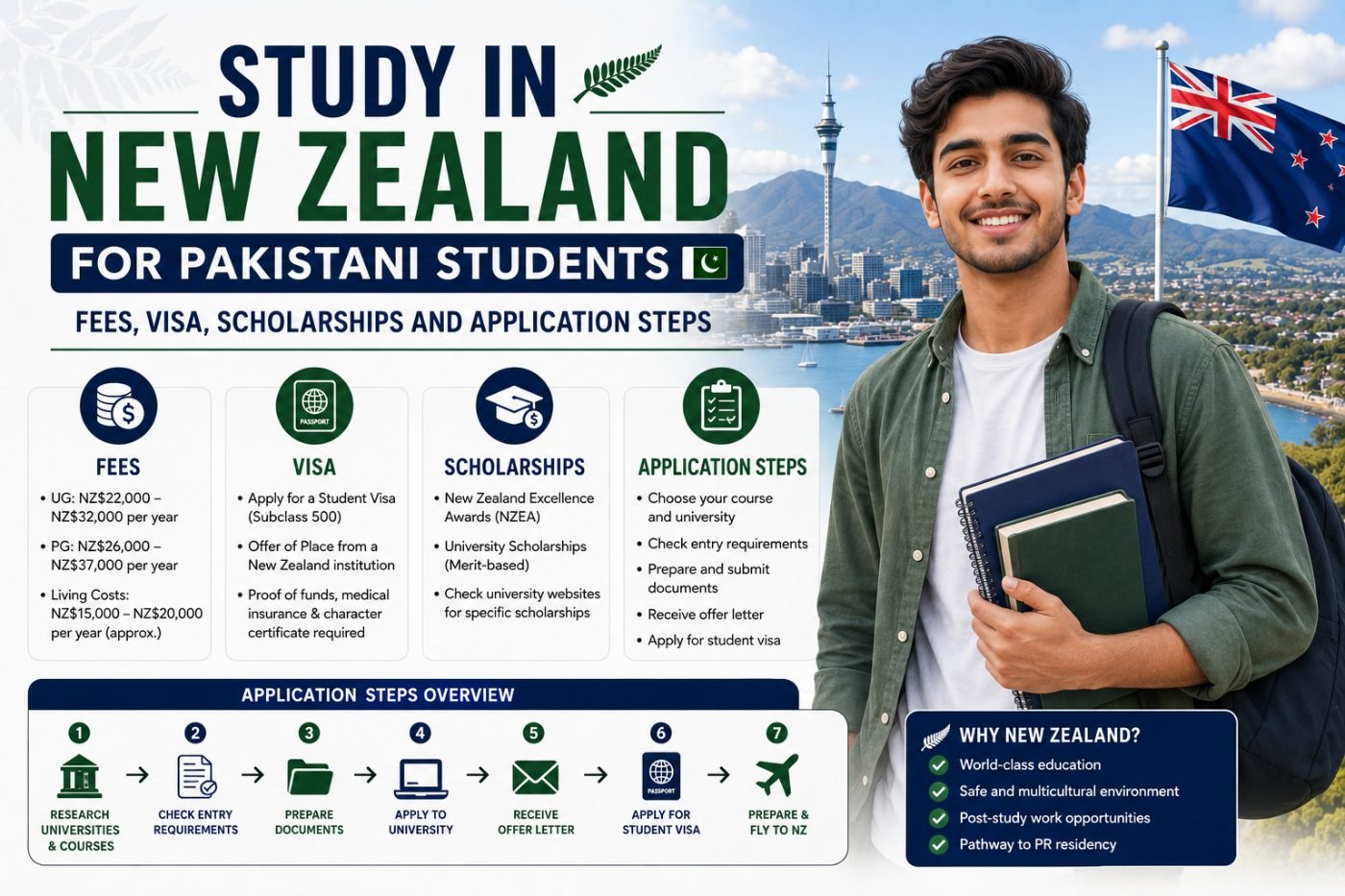
Tuition Fees for Pakistani Students
Pakistani students pay standard international tuition fees at New Zealand universities. There are no bilateral agreements that give Pakistani students access to domestic rates, with one significant exception: PhD students at most New Zealand universities pay domestic-level fees regardless of nationality — more on this below.
For standard international students, tuition fees vary by institution and programme:
Undergraduate programmes
- Arts, humanities and social sciences: NZD $25,000–$35,000 per year
- Business and commerce: NZD $28,000–$38,000 per year
- Science and IT: NZD $28,000–$40,000 per year
- Engineering: NZD $32,000–$45,000 per year
- Health sciences (nursing, pharmacy): NZD $30,000–$42,000 per year
Postgraduate taught programmes
- Arts, education, business: NZD $28,000–$38,000 per year
- Engineering, science, IT: NZD $32,000–$45,000 per year
- MBA programmes: NZD $40,000–$60,000 for the full programme
PhD and research degrees
Under New Zealand's domestic PhD fee policy, international students — including Pakistani students — typically pay NZD $6,500–$9,000 per year rather than the standard international rate of NZD $25,000–$35,000. This is one of the most significant cost advantages in the entire New Zealand system and deserves serious attention from Pakistani students considering doctoral study. A PhD at a New Zealand university, under this policy, costs less per year than an undergraduate degree at many institutions in the same country.
Living Costs for Pakistani Students
Living costs vary significantly by city. The most relevant practical guidance for Pakistani students is that more affordable cities — Dunedin (University of Otago), Hamilton (University of Waikato), and Palmerston North (Massey University) — offer a genuinely manageable monthly budget while still being proper university cities with good infrastructure.
Auckland — NZD $1,800–$2,600 per month
Wellington — NZD $1,700–$2,400 per month
Christchurch / Hamilton — NZD $1,400–$2,000 per month
Dunedin — NZD $1,350–$1,950 per month
Palmerston North — NZD $1,200–$1,800 per month
A few things Pakistani students should factor into their living cost planning that aren't always included in general guides:
Halal food availability. New Zealand's major cities — particularly Auckland — have well-established halal food infrastructure. Halal butchers, Pakistani and South Asian grocery stores, and halal-certified restaurants are readily available in Auckland, Wellington, and Christchurch. In smaller cities like Dunedin and Hamilton, halal options are available but more limited — students may cook more at home and source ingredients from specific suppliers. This is manageable, but worth planning around.
Prayer facilities. Mosques exist in all major New Zealand cities, with Auckland having the largest Muslim community and the most established Islamic infrastructure. Most universities also have designated prayer rooms or multi-faith spaces on campus. Research this for your specific city and institution before choosing where to study.
Heating costs. Pakistani students arriving from warmer climates often underestimate New Zealand's winters, particularly in Dunedin and Christchurch. Winter heating costs in older rental housing can add meaningfully to monthly budgets from June through August.
Useful Currency Context
New Zealand dollar (NZD) to Pakistani rupee (PKR) conversion fluctuates, but as a practical guide for planning purposes, NZD $1 is broadly equivalent to PKR 170–200 at typical exchange rates (verify current rates before planning). This context helps Pakistani families understand the real scale of the financial commitment in familiar terms.
When transferring money from Pakistan to New Zealand, using Wise (formerly TransferWise) or a competitive remittance service rather than a standard bank transfer typically saves meaningfully on exchange rate margins — worth researching before establishing a regular transfer arrangement.
Pakistani Academic Qualifications: How They're Assessed
Pakistani students most commonly enter New Zealand universities with one of the following prior qualifications:
O-Levels and A-Levels (Cambridge International)
These are well understood and broadly accepted by all New Zealand universities. Entry requirements are typically expressed in grade equivalents, and strong A-Level results — particularly in science, mathematics, or economics depending on your intended field — are fully sufficient for direct entry into bachelor's degree programmes.
FSc (Faculty of Science) and FA (Faculty of Arts)
FSc and FA qualifications from Pakistani intermediate boards are accepted by most New Zealand universities, though the assessment is less straightforward than for O/A-Levels. Some institutions evaluate these directly against New Zealand entry standards; others may request a NZQA (New Zealand Qualifications Authority) evaluation or suggest completing a foundation programme first.
Bachelor's degrees from HEC-recognised universities
Undergraduate degrees from Pakistani universities recognised by the Higher Education Commission (HEC) are accepted as basis for postgraduate admission at New Zealand universities. Grade conversion typically maps to New Zealand standards based on GPA or percentage result, and institutions are experienced in evaluating Pakistani university results.
Master's degrees from Pakistani universities
Accepted as basis for PhD admission and, where relevant, for entry into New Zealand professional postgraduate programmes.
If there's any uncertainty about whether your specific qualification meets direct entry requirements, contact the admissions office of your target institution directly — they have experience with Pakistani qualifications and can advise on whether direct entry or a foundation pathway is more appropriate.
English Language Requirements for Pakistani Students
English is the medium of instruction at most Pakistani institutions that prepare students for international study — O/A-Level education in Pakistan is conducted in English, and many Pakistani universities use English as their primary teaching language.
This creates a genuine possibility for a medium of instruction waiver at many New Zealand universities — meaning you may not need to sit IELTS, TOEFL, or another English test at all.
To qualify for a waiver, you generally need:
- Previous education conducted entirely in English
- A medium of instruction letter from your previous institution, on official letterhead, signed by an authorised official, explicitly stating that English was the language of teaching and assessment throughout your programme
If your O/A-Level education was in English and your university degree was in English, you have a reasonable basis for requesting a waiver. Contact your target universities directly and ask whether they grant waivers for students from English-medium Pakistani institutions — and what documentation they need.
If a waiver isn't available or your education wasn't fully English-medium, the accepted tests and typical requirements are:
- IELTS Academic: 6.0–6.5 overall for undergraduate, 6.5 for most postgraduate programmes
- TOEFL iBT: 60–80 for undergraduate, 79–90 for postgraduate
- PTE Academic: 50–58 for undergraduate, 58–65 for postgraduate
IELTS test centres are widely available across Pakistan — in Karachi, Lahore, Islamabad, Peshawar, Faisalabad, and other cities — through both the British Council and IDP networks. Book well in advance, particularly during peak application periods.
Scholarships Available to Pakistani Students
New Zealand Government Scholarships
New Zealand Scholarships (NZS) are government-funded awards for students from eligible developing countries, specifically including Pakistan. These are among the most generous scholarship programmes available to Pakistani students globally — covering full tuition fees, a living allowance, return airfares, and medical and travel insurance.
New Zealand Scholarships are available for postgraduate study (typically Master's and PhD level) in development-relevant fields. The application process is managed by New Zealand's Ministry of Foreign Affairs and Trade (MFAT), with applications typically due in March to May for the following year's February intake.
Competition is genuine — these are prestigious awards and the Pakistan allocation is limited. A strong academic record, a clear research or study focus in a development-relevant field, and well-articulated reasons for choosing New Zealand are all important. Applications require significant preparation and should be started at least three to four months before the deadline.
University-Specific Scholarships
Most New Zealand universities offer their own scholarships for international students, assessed either automatically alongside the admissions application or through a separate scholarship application process. These vary by institution:
University of Auckland — offers the University of Auckland International Student Excellence Scholarship, assessed on academic merit for high-achieving international students. Also has subject-specific awards within certain faculties.
University of Otago — offers International Excellence Scholarships for high-achieving international students, as well as postgraduate research scholarships in specific departments.
Victoria University of Wellington — offers international scholarships across undergraduate and postgraduate levels, assessed as part of the admissions process.
Massey University — offers the Massey University International Scholarship for undergraduate and postgraduate students with strong academic records.
University of Canterbury — offers international merit scholarships, with specific awards available within engineering and science faculties.
University of Waikato — offers scholarships for international students across most faculties, assessed automatically for students who meet the academic threshold.
For all of these, the key practical point is the same: apply early. University scholarships are processed on a rolling basis, and scholarship budgets are allocated progressively as strong applications arrive. A student who applies in August or September for a February intake is in a meaningfully stronger position for scholarship consideration than one who applies in December.
The PhD Domestic Fee Policy as a De Facto Scholarship
While technically a fee structure rather than a scholarship, the domestic fee policy for international PhD students at most New Zealand universities is worth treating as equivalent to a major award in terms of financial planning. Paying NZD $7,000–$9,000 per year for a PhD instead of NZD $30,000–$35,000 is a difference of roughly NZD $70,000–$90,000 over a three-year doctorate. No scholarship competition is needed to access this — it's simply how PhD fees work at most New Zealand institutions.
For Pakistani students with research interests aligned to New Zealand universities' active research areas — agriculture, environmental science, health sciences, engineering — a PhD in New Zealand with the domestic fee rate and a Research Training Program (RTP) stipend (where available) can be one of the most cost-effective doctoral options globally.
The New Zealand Student Visa Process for Pakistani Students
Pakistani students apply for a New Zealand student visa (Fee Paying Student Visa) through Immigration New Zealand's online portal. The process is manageable and predictable, though it requires careful preparation of financial documentation in particular.
Step 1 — Receive Your University Offer and Offer of Place
Your visa application cannot begin without a formal Offer of Place from your New Zealand institution. Apply for admission, receive your offer, accept it, and pay the required tuition deposit. Your institution will then issue your Offer of Place — the central document of your visa application.
Step 2 — Arrange Health Insurance
Health insurance is compulsory for the duration of your visa. Check whether your institution has arranged or recommends a specific provider, as some universities include basic cover as part of enrolment. If not, purchase from an approved provider and obtain the certificate of cover before submitting your visa application.
Step 3 — Prepare Your Financial Evidence
This is the step that requires the most careful preparation for Pakistani applicants and where the most applications encounter difficulties.
You need to demonstrate access to sufficient funds to cover:
- Tuition fees for the full course, or the first year for longer courses
- Living costs at the Immigration New Zealand benchmark — currently NZD $20,000 per year
- Return travel costs to Pakistan
Bank statements — covering the last three to six months, showing consistent balances and sufficient funds. The pattern of balances matters as much as the closing figure — funds that have been steadily present throughout the period are viewed more favourably than a large recent deposit without prior history.
Sponsorship letter and sponsor's financial documentation — if your parents or a sponsor are funding your studies (which is typical for Pakistani students), include a formal, signed sponsorship letter confirming the relationship and commitment, alongside the sponsor's bank statements for the same period, recent salary slips, and if the sponsor is a business owner, relevant business documentation.
Education loan documents — if your studies are partly funded through an HBL, MCB, or other Pakistani bank education loan, include the loan sanction letter from the bank.
Scholarship letters — if you have an award from a New Zealand institution or the New Zealand government, include the official award confirmation.
A specific note for Pakistani applicants: Immigration New Zealand processing officers are familiar with the structure of Pakistani banking and employment documentation. Present statements from recognised Pakistani banks (HBL, MCB, UBL, Meezan, Allied Bank, Bank Alfalah and others), and ensure employment letters for sponsors are on company or employer letterhead, signed, and include clear salary information.
Step 4 — Obtain a Police Clearance Certificate (PCC)
Pakistani applicants typically need to provide a police clearance certificate from Pakistan. This is obtained through the National Database and Registration Authority (NADRA) or through the relevant Superintendent of Police office depending on your district.
Processing times vary — NADRA's PCC processing has been relatively streamlined in recent years, but allow at least two to three weeks to be safe, and check current processing times before applying. The certificate must be recent at the time you submit your visa application — typically within six months.
If you've lived in another country for 12 months or more in the past ten years, you'll also need a police clearance from that country.
Step 5 — Complete a Medical Examination
Pakistani applicants for New Zealand student visas are generally required to undergo a medical examination with an approved Immigration New Zealand panel physician. This is not a surprise or an unusual requirement — it's standard for Pakistani nationals applying for New Zealand visas of this type.
Approved panel physicians in Pakistan are listed on the Immigration New Zealand website. Major cities including Karachi, Lahore, and Islamabad all have approved clinics. Book your examination as early as possible in the visa preparation process — the examination cannot be completed until your Immigration New Zealand application reference number is generated, but you can research the process and identify your nearest approved clinic immediately.
Results are submitted directly by the examining physician to Immigration New Zealand through the online system. An incomplete or delayed medical examination is one of the most common causes of processing delays in Pakistani student visa applications.
Step 6 — Submit Your Application Online
Applications are submitted through the Immigration New Zealand online portal (Immigration ONZ). Upload all supporting documents, pay the application fee (currently in the range of NZD $375–$450 — check the current fee on the Immigration New Zealand website), and submit.
Step 7 — Monitoring Your Application
Processing times for Pakistani student visa applications vary. Immigration New Zealand publishes estimated processing times on its website for different visa categories and nationalities — check these when planning your submission date relative to your programme start.
For a February intake, aim to submit your visa application by November at the latest, and earlier if possible. For a July intake, aim to submit by May. These timelines allow reasonable buffer for standard processing and some delay without cutting into your programme start date.
Step-by-Step Application Guide for Pakistani Students
Step 1 — Research and Shortlist
Identify two to four universities and programmes that genuinely fit your academic background, your career goals, and your financial situation. Consider both the headline tuition fee and the living costs in that university's city — the combination of these is your actual annual cost, not the tuition figure alone.
Step 2 — Check Your English Language Position
Determine whether you qualify for a medium of instruction waiver based on your previous education. If not, decide which English test is right for you and book a sitting early enough that your results will be available when you submit your application.
Step 3 — Request Your Academic Documents
Request official transcripts and certificates from your matric board, intermediate board, HEC-recognised university, or all three as applicable. If any documents are not in English, arrange certified translations.
Step 4 — Research Scholarships
Before submitting your application, check the scholarship deadlines at each of your target institutions. For the New Zealand government scholarship, check the MFAT deadline for the current cycle. Scholarship consideration at most institutions is strongest for early applicants — align your application submission with the scholarship window rather than the general admissions deadline.
Step 5 — Draft Your Personal Statement or Statement of Purpose
For postgraduate applications, this is one of the most important documents in your file. Be specific — explain why this programme at this institution, what in your academic and professional background leads you to this point, and what you intend to do after graduation. Tailor it for each university.
For research degree applications, identifying and contacting a potential supervisor before applying is important. Email the academic staff whose research interests align with yours, briefly introduce your background and research interests, and ask whether they're taking on new postgraduate students. A supervisor's willingness to work with you is effectively a prerequisite for a successful research application.
Step 6 — Submit Your Applications
Submit to all target institutions simultaneously rather than waiting for responses before applying elsewhere. New Zealand universities use rolling admissions — earlier applications receive earlier consideration, and scholarship budgets are allocated progressively.
Step 7 — Receive and Evaluate Offers
Once offers arrive, compare them across academic programme, scholarship availability, and living cost implications. If you receive an offer that's below your first choice but within your financial means, hold it while waiting for your preferred institution to respond — it's a viable backup rather than an obligation to accept immediately.
Step 8 — Accept Your Offer and Begin Visa Preparation
Accept your preferred offer, pay the tuition deposit, and receive your Offer of Place. Begin visa preparation immediately — don't wait until your offer acceptance settles before starting to gather financial documents and book your medical examination.
Step 9 — Submit Your Visa Application
With your Offer of Place, financial evidence, health insurance certificate, police clearance certificate, and medical examination reference in hand, submit your student visa application through the Immigration ONZ portal.
Step 10 — Pre-Departure Planning
Once your visa is approved, confirm your accommodation, book flights to arrive at least two to four days before your programme starts, and work through the practical pre-departure checklist — bank research, SIM card plan, power adapter, halal food options in your destination city, and any prescription medication you need to bring.
Community and Life in New Zealand for Pakistani Students
New Zealand's Muslim community is small relative to larger countries but well-established and genuinely welcoming. Auckland has the largest Pakistani and broader South Asian Muslim population, with multiple mosques, Pakistani community organisations, and halal-certified food businesses. The Federation of Islamic Associations of New Zealand (FIANZ) supports Muslim communities across the country and can help connect new arrivals with local mosques and community events.
Most New Zealand universities have Muslim student associations, Islamic societies, or interfaith student groups that provide a community context for Pakistani students from their first week on campus. Joining one of these early in your first semester is one of the most effective ways to build a support network quickly.
Eid celebrations are observed by Muslim communities across New Zealand's major cities, and the broader New Zealand cultural attitude toward religious practice is generally respectful and non-intrusive. Pakistani students typically find New Zealanders genuinely curious about their background rather than unfamiliar with it — a country with a strong multicultural identity and an active international student community tends to foster this.
How Uni Navigators Can Help
At Uni Navigators, we work with Pakistani students throughout the entire New Zealand application journey — from choosing the right university and programme for your academic background and budget, to putting together your visa file, to planning your arrival.
We understand how Pakistani academic qualifications are assessed by New Zealand institutions, where the medium of instruction waiver is likely to apply, and what Immigration New Zealand expects from Pakistani applicants in terms of financial documentation. We know which universities are actively recruiting Pakistani students, where the most relevant scholarships are, and how to position your application to give you the strongest possible chance.
Our support includes:
- University shortlisting based on your qualifications, budget, and career goals
- English language requirement assessment and waiver guidance
- Personal statement and research proposal preparation
- Scholarship identification — including New Zealand government scholarships and university awards
- Complete student visa file preparation, including financial document review
- Medical examination and police clearance guidance
- Pre-departure planning and arrival support
Book a free consultation with Uni Navigators today and get a personalised plan for your New Zealand study journey — built around your specific qualifications, budget, and goals.