Why Ireland Should Be on Every International Student's Radar
Ireland does not always make the top of students' lists when they first start researching study destinations. The UK, Canada, and Australia tend to get the most attention. But spend five minutes looking at what Ireland actually offers, and the picture changes quickly.
It is an English-speaking country inside the European Union — a combination that very few countries can offer. That means you study in a language you already know, while gaining access to the broader EU job market after you graduate. Add to that a genuinely world-class university system, a booming tech and pharma sector, and some of the most generous post-study work rights in Europe, and Ireland starts looking like a very smart choice.
Universities like Trinity College Dublin, University College Dublin, and University College Cork consistently rank among the top universities globally. Major employers including Google, Meta, Apple, Microsoft, and Pfizer have chosen Ireland as their European base — which directly translates into real internship and graduate employment opportunities for students.
Cost of Studying in Ireland
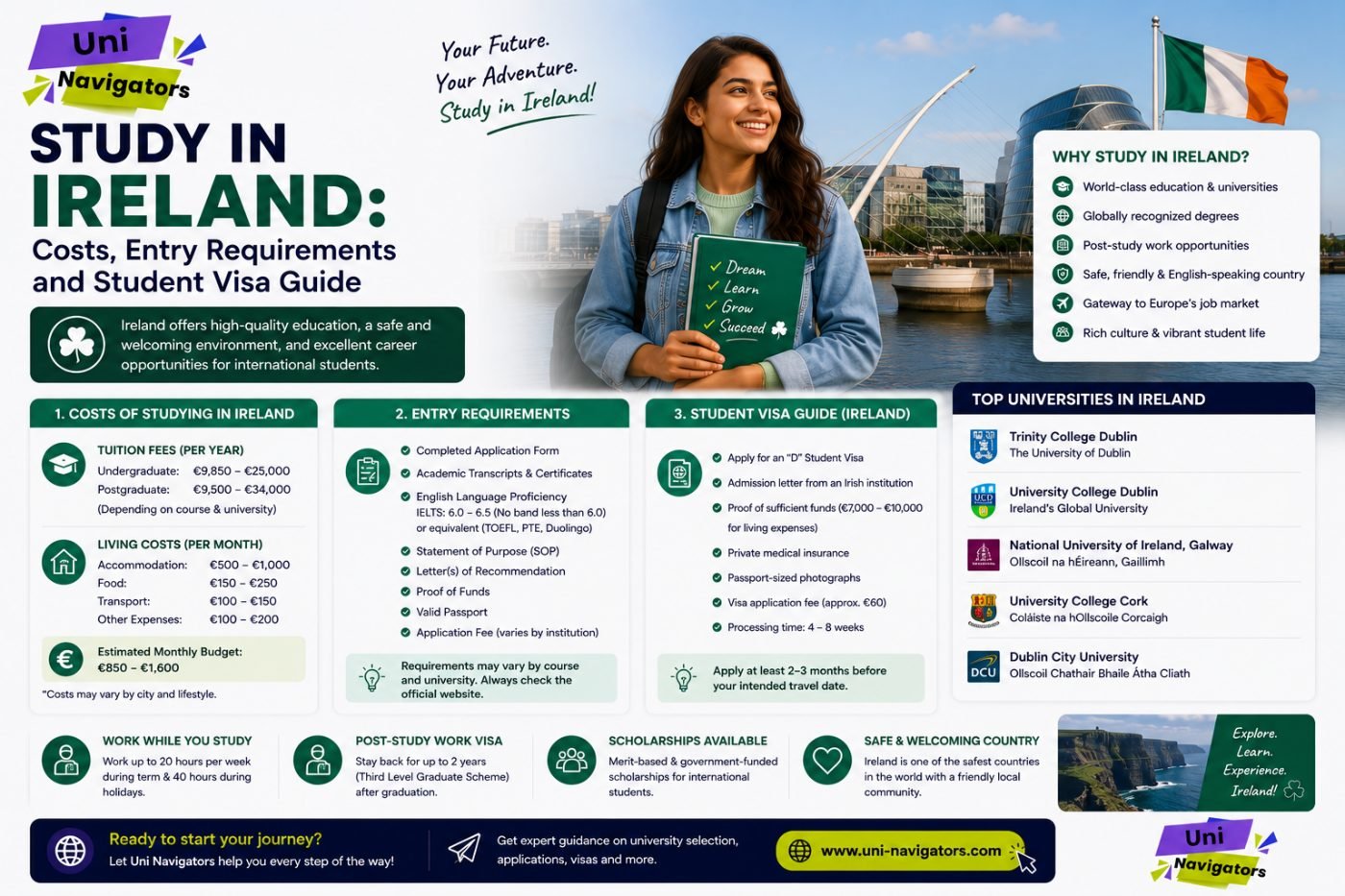
Understanding the full cost before you apply is essential. There are two main categories to plan for: tuition fees and living expenses.
Tuition Fees for International Students
Ireland distinguishes between EU and non-EU students when it comes to fees. As an international student from outside the EU, you will pay the higher non-EU rate. Here is a general breakdown of what to expect:
- Undergraduate programmes: €9,000 to €25,000 per year
- Postgraduate taught programmes: €10,000 to €35,000 per year
- MBA and business programmes: €20,000 to €45,000 per year
- Medicine and dentistry: €35,000 to €60,000 per year
- Research degrees (MPhil, PhD): €6,000 to €20,000 per year
Fees vary significantly between institutions and subject areas. Technology, engineering, and medicine tend to be at the higher end. Arts, humanities, and social science programmes are generally more affordable. Always confirm the exact fee on your chosen university's course page before applying.
Cost of Living in Ireland
Your living costs will depend heavily on which city or town you study in. Dublin is the most expensive location by a considerable margin. Other cities like Cork, Galway, Limerick, and Waterford offer a lower cost of living while still hosting excellent universities.
As a general guide, budget for the following monthly expenses:
- Accommodation (shared): €600 to €1,100
- Food and groceries: €200 to €350
- Transport (Leap card or bus pass): €60 to €100
- Books and study materials: €30 to €60
- Mobile phone and utilities: €40 to €80
- Social and leisure: €100 to €200
In Dublin, a realistic monthly budget sits between €1,200 and €1,800. Outside the capital, you can live comfortably on €900 to €1,300 per month.
A note on part-time work: Non-EU students holding a valid Irish student permission can work up to 20 hours per week during term time and 40 hours per week during official holiday periods. This can help offset a meaningful portion of your living costs.
Entry Requirements for Irish Universities
What you need to gain admission depends on the level of study you are applying for and the specific programme. Below is a general overview of what Irish universities typically expect.
Undergraduate Entry Requirements
Irish universities accept a wide range of international qualifications including A-Levels, the International Baccalaureate (IB), and equivalent secondary school leaving certificates from South Asia, Africa, the Middle East, and the Americas.
Grade expectations vary by course. Highly competitive programmes such as Computer Science at Trinity College Dublin or Medicine at University College Cork may require the equivalent of AAA or higher at A-Level. Less competitive programmes may accept BBC or lower.
Students whose qualifications do not meet direct entry standards may be offered a place on a foundation year or pathway programme, which then leads into the first year of their chosen degree.
Postgraduate Entry Requirements
For taught Master's programmes, you will generally need:
- A relevant undergraduate degree, typically at 2:1 level or above (or international equivalent)
- A personal statement or statement of purpose
- Two academic references
- A CV or resume
- English language test results (if applicable)
- Some programmes also require a GMAT score (business) or a portfolio (design, architecture, creative arts)
PhD and research degree applications additionally require a research proposal and, in most cases, a confirmed supervisor before an offer is made.
English Language Requirements
If English is not your first language or your previous studies were not conducted in English, you will need to provide an approved English language test score. Standard requirements are:
- IELTS Academic: 6.0 to 6.5 overall, with no individual band below 5.5
- TOEFL iBT: 79 to 90
- PTE Academic: 59 to 64
- Duolingo English Test: 110 to 120 (accepted by a growing number of institutions)
Always check the specific language requirement for your chosen course, as competitive programmes sometimes require higher scores than the institutional minimum.
Top Universities in Ireland for International Students
Ireland has a relatively small but high-quality university sector. The institutions below are the most commonly chosen by international students:
- Trinity College Dublin (TCD) — Dublin's oldest university, ranked in the global top 100, strong in arts, law, science, and computer science
- University College Dublin (UCD) — Ireland's largest university, highly regarded for business, engineering, agriculture, and medicine
- University College Cork (UCC) — Strong in medicine, law, and sciences, with a vibrant student community
- University of Galway (NUI Galway) — Known for marine science, engineering, and the arts; located in one of Ireland's most beloved cities
- Dublin City University (DCU) — A modern university with strong industry links in communications, computing, and business
- University of Limerick (UL) — Known for its cooperative education model with mandatory work placement, particularly strong in engineering and sports science
- Technological University Dublin (TU Dublin) — The largest technological university in Ireland, offering a broad range of applied programmes
Ireland Student Visa: Step-by-Step Guide
Non-EU students who plan to study in Ireland for more than 90 days need to apply for a Long Stay 'D' Student Visa. Here is how the process works from start to finish.
Step 1 — Secure Your University Offer
Before you can do anything else, you need a letter of acceptance from a recognised Irish higher education institution. Make sure the offer is unconditional, or that you have satisfied all outstanding conditions, before you proceed.
Step 2 — Pay Your Tuition Fee or Deposit
Most Irish universities require you to pay your tuition fee — or at minimum a substantial deposit — before they will issue the formal enrolment documentation needed for your visa application. This is a key step that many students underestimate in terms of timing.
Step 3 — Gather Your Documents
A complete Irish student visa application typically requires the following:
- Valid passport with at least 12 months validity beyond your intended return date
- University acceptance or enrolment letter
- Proof of tuition payment or deposit receipt
- Bank statements showing sufficient funds (minimum €7,000 to €10,000 is generally expected)
- Academic transcripts and certificates
- English language test results (where applicable)
- Proof of accommodation in Ireland
- Travel and health insurance documents
- Two recent passport-sized photographs
Step 4 — Apply Online and Pay the Visa Fee
Visa applications are submitted through the INIS (Irish Naturalisation and Immigration Service) Visa Online System. Once your online application is complete, you will pay the application fee:
- Single journey visa: €60
- Multi-journey visa: €100
After paying, you will be required to attend an appointment at the nearest Irish embassy, consulate, or designated visa application centre to submit your biometric data and original documents.
Step 5 — Wait for a Decision
Processing times vary depending on your country of residence and the time of year. In general, allow four to eight weeks for a decision. Applying at least ten weeks before your course start date is strongly advisable to avoid any last-minute delays.
Step 6 — Register on Arrival in Ireland
Once you arrive in Ireland, you have 90 days to register your presence with immigration authorities. In Dublin, this is done online through the Irish Immigration website. Outside Dublin, you register in person at your local Garda (police) registration office.
Registration gives you your Irish Residence Permit (IRP) card, which is your official proof of permission to live and study in the country. You will need your passport, enrolment letter, proof of address, and a registration fee of €300.
Your IRP must be renewed each year while you are studying. Keep your address and enrolment status up to date with INIS throughout your studies.
Post-Study Work Options in Ireland
This is where Ireland genuinely stands out from most European competitors. Under the Third Level Graduate Programme, non-EU graduates are entitled to remain in Ireland to seek employment after completing their degree:
- Bachelor's degree graduates: 12 months post-study permission
- Master's degree graduates: 24 months post-study permission
- PhD graduates: 24 months post-study permission
There is no requirement for employer sponsorship during this period, and no minimum salary threshold to meet initially. Once you secure a job, you can transition to a General Employment Permit or a Critical Skills Employment Permit, both of which offer a pathway to long-term residency.
Scholarships Available for International Students in Ireland
Funding your studies in Ireland is competitive, but options do exist. The following are worth researching early:
- Government of Ireland International Education Scholarship (GOI-IES): A prestigious government-funded scholarship covering full tuition and a monthly stipend, open to high-achieving students from outside the EU
- University merit scholarships: Most Irish universities offer their own scholarships for high-achieving international students, often applied for during the admissions process
- Science Foundation Ireland funding: Available for postgraduate research students in STEM fields
- Fulbright Programme: For students from the United States applying to Irish institutions
- Aga Khan Foundation bursaries: For students from specific developing nations
Apply for scholarships as early as possible — most have deadlines several months before the academic year begins.
Is Ireland the Right Study Destination for You?
Ireland suits students who want the credibility of a world-recognised English-language degree, real access to the European job market, and a post-study work pathway that does not come loaded with bureaucratic hurdles.
It is not the cheapest destination in Europe — that title goes to countries like Hungary, Bulgaria, or Poland. But for the quality of education, the employment landscape, and the quality of life, Ireland offers very strong value for money, particularly at postgraduate level.
If you are applying from South Asia, Africa, or the Middle East, Ireland is also a country where your qualifications are genuinely understood and where universities actively recruit international students with clear, transparent entry criteria.
How Uni Navigators Can Help You Study in Ireland
Applying to Irish universities involves more moving parts than most students expect — from choosing the right course and institution, to preparing a strong personal statement, to navigating the visa process and planning your arrival.
At Uni Navigators, we guide students through every stage of that journey. Our team has helped students from Pakistan, India, Nigeria, the UAE, Saudi Arabia, and many other countries secure places at Irish universities and successfully obtain their student visas.
We offer support with:
- University shortlisting and course selection
- Application preparation and personal statement writing
- Document review and visa file preparation
- Pre-departure planning including accommodation and arrival support
Book a free consultation with our team today and take the first step towards studying in Ireland.